.png)
Context
The objective of this document is to provide the law-firm-client with a platform on which to build a model that supports their vision for non-chargeable activity for a timely and accurate evaluation of related opportunity service costs and out of pocket expenses.
Acumin offers a variety of options on how to structure matters as well as time and disbursement codes needed to capture non-chargeable activities and related expenses, to provide the organization with activity-relevant and project-based reporting opportunities with greater degrees of reporting-granularity.
Non-chargeable time is often considered an investment in client-specific marketing and goodwill endeavours as well as in non-client related activities that yield value to the organization’s business environment. Time-investments for non-chargeable activities are often supported with relevant expenses recorded in the general ledger.
When time and out-of-pocket investments are recorded and managed through a non-chargeable matter structure with non-chargeable time & disbursement code use limited through task-sets, the firm has greater visibility and management opportunities of the transactional details as well as use of additional reporting dimensions for greater context and perspective in decision making.
Non-Chargeable Activities Model
Concepts and Fundamentals
Existing matter and entry code business logic provides a comprehensive feature-rich structure for capturing and measuring client-facing and internal non-chargeable productive-time and related expenses. When combined with reporting dimensions native to the application – areas of practice, areas of practice group, areas of practice class, group-client, and industry; as well as relevant functionality - chargeable equivalencies, pro-bono and special chargeable status, matter specific task-sets, use of matter budget fields and supporting BPR rules; the resulting outcome allows for the effective management of non-chargeable time and disbursement investments mad throughout the firm’s business cycles.
Productive Non-Chargeable Activities
Types of matters typically considered when building a non-chargeable activities structure:
Chargeable Matters
Matter-specific productive non-chargeable time and expenses spent on chargeable matters for named-clients is typically considered as a goodwill investment and therefore tracked as zero-rated time and disbursements on the affected chargeable matter. This process ensures that the investment is measurable as a reporting category for the timekeeper and supporting reporting dimensions as well as considered in the overall profitability model of the affected client.
Chargeable Matters - Special Status
Intended to track time and expenses spent for specially remunerated work with an expected collection-value equal to or below cost which is not fully known at the start of the engagement.
Identified through an organization defined qualification process, these special status chargeable matters are typically set up for named clients along with non-relevant rate structures (for example 1.00 per hour). During the life of the matter, the work can be evaluated in consideration of chargeable hour guidelines and re-valued once the remuneration for the activity or project is known eliminating non-relevant variance measures through its life cycle.
Internal Staff Matters
These matters are intended to track non-chargeable time and chargeable expenses spent in support of the firm’s policy for working on staff-matters. It provides decision makers with visibility of investments made in this capacity for named clients within affected areas of practice. At the discretion of the firm, some, or all the non-chargeable work of affected working members can be considered as chargeable equivalent, instead of using chargeable matters, generating unwanted variances and departures from effective rates.
Pro-bono Matters:
These specially identified non-chargeable time matters are intended to track time investments and chargeable expenses spent on named clients and area of practice to support the firm’s commitment to giving back to the community.
Specially Remunerated Matters
These matters are intended to track non-chargeable time spent in support of the firm’s policy for timekeepers participating on boards, external audit committees etc. for which they will receive minimal remuneration. It provides decision makers with visibility of investments made in this capacity for named clients and exposure as a practice development activity. At the discretion of the firm, some, or all of the non-chargeable work of affected working members can be considered as chargeable equivalent, instead of using chargeable matters, generating unwanted variances and departures from effective rates.
Marketing and Business Development Matters
Client-Specific Practice Development Marketing Efforts & Events Matters:
Typically set as matter “0”, these matters are intended to track non-chargeable time and expenses spent on client-specific practice development marketing efforts & events for named-clients, in support of the firm’s commitment to earning new work from new and/or existing clients. Non-chargeable expenses captured in this matter are not only reflected in the general ledger for a financial reporting perspective but can also be considered in context of management reporting options for affected clients using supporting client and/or matter reporting dimensions.
Client-Specific Relationship & Goodwill Investment Matters:
Typically set as matter “99999”, these matters are intended to track non-chargeable time and expenses spent on activities which are not of a marketing nature, aimed to nourishing goodwill with existing clients. Non-chargeable expenses captured in this matter, if any, are not only reflected in the general ledger in the general ledger for a financial reporting perspective but can also be considered in context of management reporting options for affected clients using supporting client and/or matter reporting dimensions.
Practice Development, Marketing, Public Relations, and Community Service Matters:
These non-chargeable time and disbursement matters are typically created within an internal firm client created for this use case. Typically, this law-firm client includes multiple matters aligned to the various marketing budgets often including firm-wide activities and events, office-specific activities and events, practice-group activities, and events as well as member-specific and project-based ones. Non-chargeable expenses captured in this matter if any, are not only reflected in the general ledger for a financial reporting perspective but can also be considered in context of management reporting options for affected clients using supporting client and/or matter reporting dimensions.
Professional Development and Continuing Education Matters:
These non-chargeable time and disbursement matters are typically created within an internal firm client created for this use case. Typically, this law-firm client includes multiple member-specific matters for professionals and functional department matters for non-professional staff. Non- chargeable expenses captured in this matter if any, are not only reflected in the general ledger for a financial reporting perspective but can also be considered in context of management reporting options for affected clients using supporting client and/or matter reporting dimensions.
Firm Management, Administration and Operations:
These non-chargeable time and disbursement matters are also created within an internal firm client created for this use case. Typically, these are activity-based matters on which all timekeepers record their time. Non-chargeable expenses captured in this matter, if any, are not only reflected in the general ledger for a financial reporting perspective but can also be considered in context of management reporting options for affected clients using supporting client and/or matter reporting dimensions.
Committee Work Matters:
As with firm management and administration matters, these non-chargeable time and disbursement matters are created within an internal firm client created for this use case. Typically, these are committee-based matters on which all timekeepers working for the committee record their time. Non-chargeable expenses captured in this matter are not only reflected in the general ledger for a financial reporting perspective but can also be considered in context of management reporting options for affected clients using supporting client and/or matter reporting dimensions.
Non-Productive Non-Chargeable Activities
Absences, Time-off and Vacation:
These non-chargeable time and disbursement member-specific matters must be created within the internal firm client identified within the properties of the main firm (001). Typically, these member-specific matters are used to track the timekeepers’ non-productive time so it can be taken into consideration in the calculation of the chargeable time pace needed to meet chargeable time targets for the fiscal period.
Non-Chargeable Time and Disbursement Codes
The chargeable matter is focused on chargeable activities, therefore time-investments which are not intended to be recovered, are recorded using firm-defined unambiguous non-chargeable time codes created for specific scenarios and use-cases of permitted non-chargeable undertakings on chargeable matters. These time codes are typically created in alignment with the firm’s strategy on the type of permitted non-chargeable investments specific to client-facing chargeable-matters.
Native to the application, non-chargeable time captured within chargeable matters is considered under a “Goodwill Investment” umbrella without compromising the association of the non-chargeable investment to the matter and its related reporting dimensions.
The chargeable matter can also include zero-rated (non-chargeable) disbursements. This rating option does not represent a separate non-chargeable disbursement structure. Disbursements created for client consumption can be zero rated (set as non-chargeable) in relation to clients and/or chargeable matters. Typically, the expense field of the properties form of the disbursement codes used to create otherwise chargeable disbursement entries are associated to a GL account for “Non-Recoverable Chargeable-Matter Client Disbursements”. As a result, all the firm-expense for non-recovered disbursements that are client-facing are captured within one GL account but can also be reported based on client and/or matter reporting dimensions.
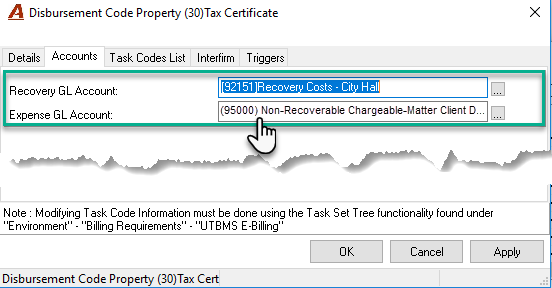
Fully non-chargeable matters are often used for tracking non-chargeable time as well as related expenses.
Through a non-chargeable disbursement-code structure, these expenses are automatically recorded onto the GL based on the code-GL account mapping included within the properties form of the disbursement code.
This structure allows for internal expenses recorded in context of the firm’s GL Accounts to have additional reporting dimension opportunities and context from a management reporting perspective.
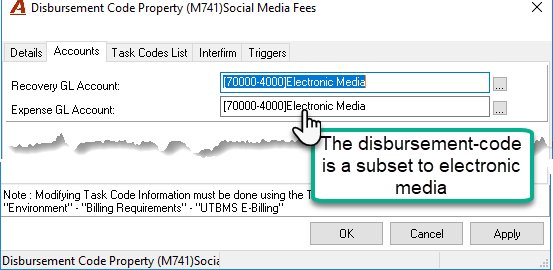
In this case, the expenses (disbursement codes) can be created as sub-sets of the related GL account included in the expense field of the disbursement code providing greater granularity when reporting main activity-based costs.
Note to reader:
A non-chargeable matter structure, which will also be used for tracking related expenses, requires a supporting non-chargeable disbursement code structure as well as a corresponding expense type/disbursement code mapping matrix at the time that the law-firm client implements the use of expense reports.
Non-Chargeable Matters
Structure and Attribute
The timekeeper – working member – is native to the non-chargeable matter structure. As a result, unless there are specific controls and restrictions which would warrant the use of member-specific matters, the non-chargeable matter structure often includes matters per reporting classification (partner, associate etc.) as well as matters for the various practice-groups, offices, committees and major events or activities. This type of structure facilitates the grouping of information into a model that supports the vision of the firm with respect to non-chargeable time, without limiting member or code specific reporting opportunities.
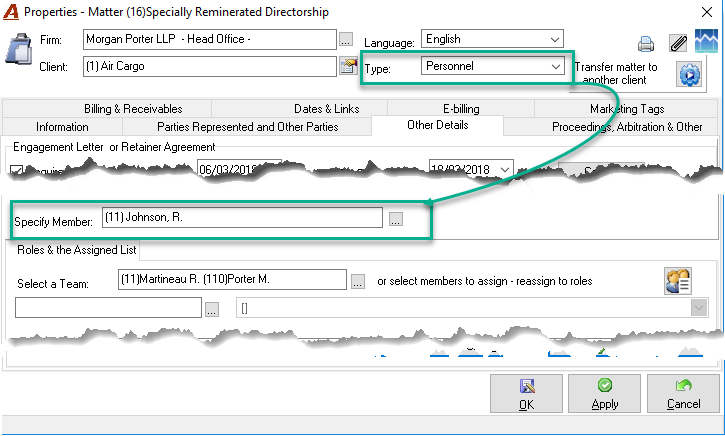
Where needed, the non-chargeable matter structure can include member-based matters with a formalized one-to-one relationship between matter and timekeeper. These are typically set-up as matter-type marketing or personnel. By adding the affected member into the specified member field in matter properties when either of these matter types are used, the relationship between matter and timekeeper is more controlled.
Using areas of practice areas, non-chargeable matters can be grouped into meaningful reporting dimensions. These broader groupings allow for the presentation of time investments on the Member’s Hours Worked dashboard as well as offer a variety of reporting opportunities for time and expenses. As areas of practice can also be rolled up into areas of practice groups and areas of practice class, the matter attribute can offer multiple perspectives for decision making.
Most law-firm clients are involved in pro-bono files, offer programs for staff matters and/or encourage member participation with other organizations that can result in specially remunerated work such as fees for being on the board of directors etc. As with marketing and other types of non-recoverable client or chargeable-matter-specific work; these types of activities are ultimately client related, therefore most firms create non-chargeable matters within the client’s matter structure, for a best-of reporting opportunity of non-chargeable work performed.
The use of internal task-sets with non-chargeable matters allows for control of the type of activity and expense intended for the affected non-chargeable matter, ultimately providing better information to the decision maker. For example, the type of activities and expenses we may expect to accept on a member-specific “Personal Business Plans & Practice Development” matter is very different from the type of activities and expenses we may expect to accept on a “Professional Association – Membership & Events” matter. The use of a task set will control the permitted activities for each.
Highlights
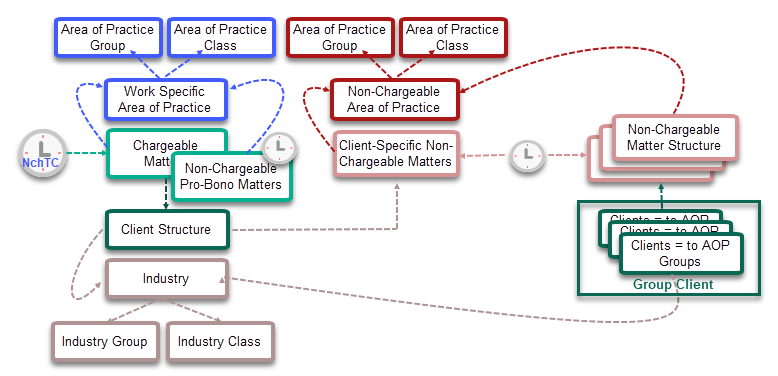
Time and disbursements recorded within non-chargeable matters are always non-chargeable regardless of the default chargeability of the time or disbursement code used or the ability for the user to change the default chargeability status of an entry.
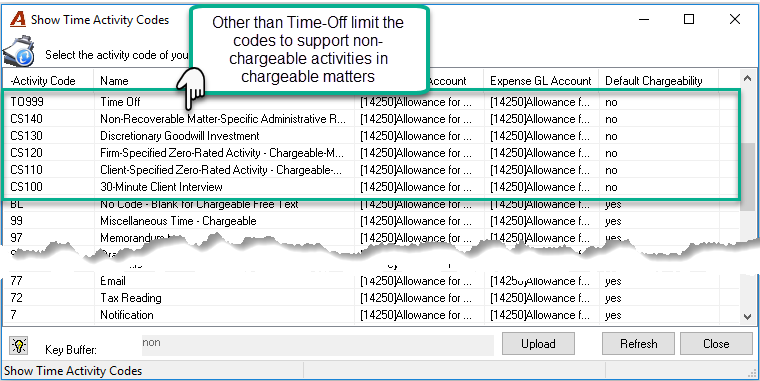
Non-chargeable time recorded within a chargeable matter requires the use of an activity based non-chargeable time code, whereas the non-chargeable disbursements require that the rate be set as non-chargeable (zero-rated).
The use of non-chargeable activity-specific time codes for chargeable matters; the use of task-sets to control the time codes (not necessarily non-chargeable) used with non-chargeable matters; and an effective mapping of disbursement codes and GL account in consideration of where the value of the disbursement entry should be recorded within the general ledger when used with a non-chargeable matter re considered as key elements of an effective non-chargeable activity structure.
Zero-Rated or Non-Chargeable Time in Chargeable Matters
Zero-rated time or non-chargeable time applied to chargeable matters is client-facing, designed to affect a specific desired outcome for the client. As a result, at the user’s discretion, zero rated non-chargeable time and/or disbursements included in the invoice properties of a chargeable matter, can be included within the invoice document for client consumption.
Although the fees billed and fees collected allotments are applied in context of the chargeable worked value, the non-chargeable (zero-rated) time is considered within matter profitability measures.
Best Practice: Using special non-chargeable time codes, general users are encouraged to track zero-rated activity to be displayed on the invoice for client consumption without being granted the right to change entry chargeability.
Track firm-specified zero-rated activities on a chargeable matter. For example:
Track client-specified zero-rated activities on a chargeable matter. For example, attendance at a training session at the request of the client;
Goodwill gesture: non-chargeable time is presented as zero rated on the invoice at the discretion of the client service team or member responsible for the matter;
To track administrative work. For example, tracking the time invested by the timekeeper responsible for collections within the actual matter to be collected.
Use Case
Firm-specified zero-rated activity on a chargeable matter;
For example: Record the 30-minute free consultation – firm business development program.
-
Firm-specified zero-rated activity on a chargeable matter for new hires;
-
Professional development;
For example: The time spent by a new lawyer on attendance at a hearing. The client sees the additional member. Seeing the details on the invoice as zero rated provides the client with visibility that the new member is not being trained at their cost.
Client-specified zero-rated activity on a chargeable matter;
For example: Record the 1.0 planning meeting on communication protocols required for the matter.
Discretionary goodwill investment completed by the timekeeper;
For example: Record the 45-minute additional research which the client was not expecting as a measure of goodwill. The entry will be displayed on the invoice for visibility to the client.
Non-recoverable matter-specific administrative requirements.
For example: Record the 20-minute collection call.
Note to reader: Limit the non-chargeable timecodes to permitted activities within chargeable matters. The timecodes to be used within non-chargeable matters should only be created if needed in which case they should be associated to the affected task set to limit misuse.
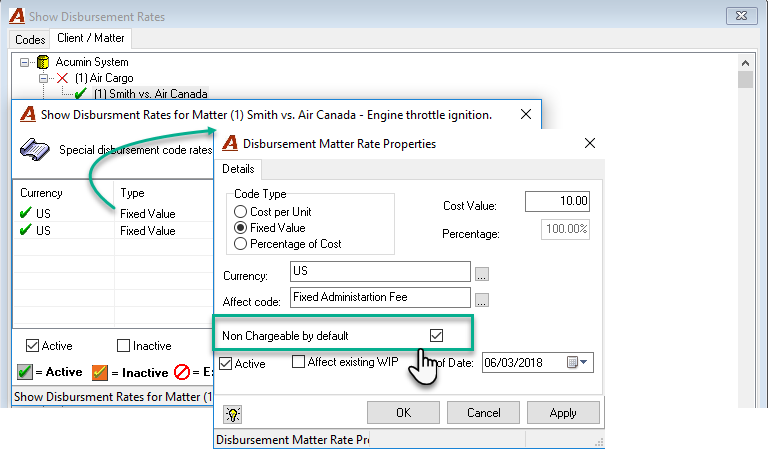
Disbursements which will not be recovered are captured using a special client or matter rate disbursement rate structure. In this case, the expense field of the disbursement code is associated to a GL account for “non-recoverable zero-rated chargeable-matter client- disbursements”.
Chargeable Matters – Special Status
The firm’s vision may include taking on client-facing work with an expected collection-value equal to or below cost, values not fully known at the start of the engagement. In this case, subject to an organization defined qualification process to ensure strategic compliance, these matters are created for named clients with time and disbursements set as chargeable but special, with a non-impacting rate structure (for example 1.00 per hour).
During the life of the matter, the affected timekeepers as well as other role bearers and decision makers can evaluate the time investment in consideration of chargeable hour guidelines. The time investment is then re-valued once the remuneration for the activity or project is known to mitigate misleading variance measures throughout the life of the engagement. Some firms manage their internal staff matters using this model.
Staff Matters
Staff-matters are intended to capture time and disbursements for services rendered to a staff member or other professional working for the firm. The staff-matter is created with the member as the client, an industry equal to “Staff/Member” and the matter reflective of its most appropriate area of practice for the work to be completed, restricted to selected allowable members in context of privacy policies.
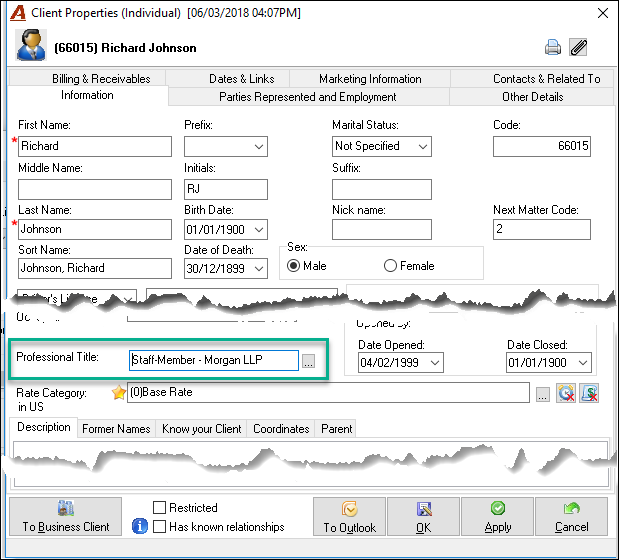
Depending on the firm’s plan for services rendered to its staff members, this matter may be set as non-chargeable for time but chargeable for disbursements, or as a fully chargeable matter with pre-set limited fees, fee-based percentage discounts or assigned to a special internal staff-rate category. Staff matters created with time set to non-chargeable, can have all or some of the non-chargeable effort considered as chargeable equivalent.
Creating a structure for supporting staff matters provides decision makers with visibility of investments made in this capacity for member-clients within affected areas of practice.
Pro-Bono Work:
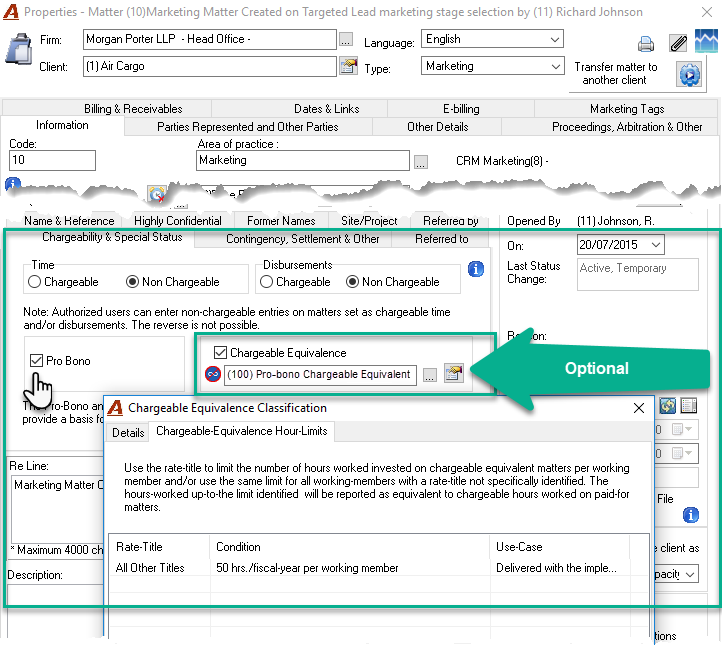
Client-facing pro-bono work is typically tracked within a non-chargeable matter for the named-client. In addition to its chargeability status and the ability for pro-bono matters to retain an area of practice reflective of the work, the matter is identified as pro-bono with the ability to set chargeability equivalent limits. In creation of these matters, consider setting role definitions for further dimensions in reporting. For example: the matter level billing and WIP management member can be assigned to the member responsible for managing the firm’s pro-bono work commitments and setting its vision.
Specially Remunerated Work
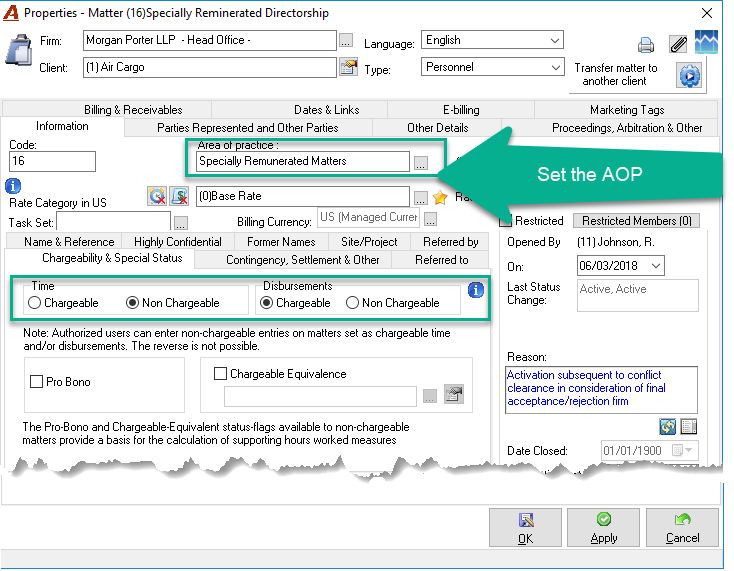
Members participating on boards, external audit committees etc. typically receive some level of minimal remuneration for their efforts. To provide firm decision makers with visibility of investments made in this capacity for named-clients and then provide exposure of this type of effort as a practice development activity, affected timekeepers are asked to record their time within a non-chargeable-time matter, type “personal” for the client affected. The non-chargeable matter will be associated to the member affected using the “member assigned” field in matter properties.
Although these matters are created as matter type “personal”, intended to track time and expenses spent for specially remunerated work, these matters are best set up with a clearly defined area of practice to define its intent; for example, “Special Remuneration Matters”. If any fees are received for their work, these can be recorded as a chargeable disbursement and invoiced. This way, the member’s realization rate is not negatively affected. At the discretion of the firm, some, or all the non-chargeable work of affected working members can be considered as chargeable equivalent, instead of using chargeable matters, generating unwanted variances and departures from effective rates.
Internal Non-Chargeable Productive Activities
Create areas of practice for the non-chargeable matter structure in consideration of the firms’ use of the broad categories highlighted within the concepts and fundamentals section of this document and leverage the area of practice group and area of practice class to group the areas of practice under two different perspectives.
Define the non-chargeable matter’s type as marketing or personnel to set the member-specific non-chargeable matter with the member in the specified member field and formalize the link between member and matter;
Create an internal client for each non-chargeable area of practice group. When creating these internal clients:
-
Use the name of the firm followed with “… – the name of the area of practice group”. Although the client will be assigned the next client number override the number to something very easy to recall and key-in.
-
Assign the client to the industry “Internal Law Firm Client” and a parent group client “Internal Law Firm Clients”.
For each of these internal clients create corresponding non-chargeable matters with an area of practice assigned to the practice group used to name the internal client. Use matter budgets and WIP limit triggers to control non-chargeable activities in non-chargeable matters.
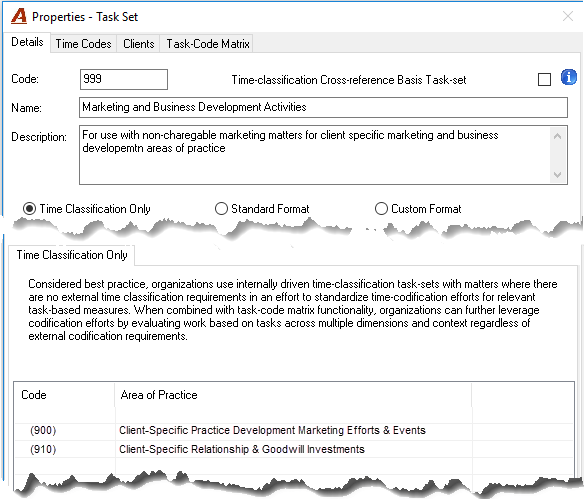
Create and assign internal task sets that include a limited number of time codes and expense codes for the affected matters. This ensures that timekeepers will have a more structured outcome when working with non-chargeable matters providing a better basis for reporting and decision making.
Recommendation
|
|
Comments |
Areas of Practice |
|
|
Group |
Class |
||
|
Client-Specific Practice Development Marketing Efforts & Events. Matter-type: Marketing Use of task-set* |
Create a client-specific marketing-efforts and events matter “0” for use with targeted existing or prospective clients with a task-set for permitted activity & expense codes. Assigned list to include the client service team |
Marketing & Business Development Endeavours |
Client-Specific Marketing , Practice Development and Goodwill |
|
Client-Specific Relationship & Goodwill Investments. Matter-Type: Marketing Use of Task Set* |
Create a client-specific matter “99999” or equivalent for use with targeted existing clients with a task-set to pre-set permitted activity & expense codes. Assigned list to include the client service team |
||
|
Specially Remunerated Work Matter type: Personal Use of task-set* |
Create a client-specific non-chargeable matter. Set the timekeeper executing the specifically remunerated work as the specified member. |
||
|
Personal Business Plans & Practice Development Endeavours Matter-type: Marketing Use of task-set* |
Create a restricted member-specific non-chargeable matter with the member code as the matter code for the firm-marketing client. Include the timekeeper as the specified member |
Business Plans & Practice Development Endeavours |
|
|
Practice Group Business Plans & Practice Development Endeavours Matter-type: Marketing Use of task-set* |
Create a restricted practice group-specific non-chargeable matter with the practice group code as the matter code for the firm-marketing client. Use role-assignments to set the practice group leader |
||
|
Office-Specific Business Plans & Practice Development Endeavours Matter-type: Marketing Use of task-set* |
Create an office-specific non-chargeable matter with the office code as the matter code for the firm-marketing client. Use role-assignments to set the managing partner for the office |
||
|
Professional Association – Membership & Events Matter-type: Marketing Use of task-set* |
Create a restricted member-specific non-chargeable matter with the member code as the matter code for the firm-marketing client. Include the timekeeper as the specified member |
||
|
Traditional Advertising Media Matter-type: Marketing Use of task-set* |
Create traditional advertising media specific non-chargeable matters (i.e., Magazine ads, television etc.) for the firm-marketing client. Use role-assignments to set the person responsible for the managing the advertising medium |
Advertising Media |
|
|
New Advertising Media Matter-type: Marketing Use of task-set* |
Create new advertising media specific non-chargeable matters (i.e., social media, bogs & websites, text campaigns etc.) for the firm-marketing client. Use role-assignments to set the person responsible for the managing the advertising medium |
||
|
|
Comments |
Areas of Practice |
|
|
Group |
Class |
||
|
Speaking engagements, Writing/Publishing Efforts Matter-type: Marketing Use of task-set* |
Create activity specific non-chargeable matters for the firm-marketing client. Use role-assignments to set the person responsible for the managing the activity (if any) |
Continued…. Marketing & Business Development Endeavours |
Public Relations and Community Service |
|
Political and Public Relations Matter-type: Marketing Use of task-set* |
Create activity specific non-chargeable matters for the firm-marketing client. Use role-assignments to set the person responsible for the managing the activity (if any) |
||
|
Community Service & Charitable Contributions Matter-type: Marketing Use of task-set* |
Create activity specific non-chargeable matters for the firm-marketing client. Use role-assignments to set the person responsible for managing the activity (if any) |
||
|
Professional Development, Seminars and/or Conferences Matter-type: General Use of task set* |
Create activity & practice group specific non-chargeable matters for the firm’s CLE-client. Use role-assignments to set the practice group leader and the person responsible for managing the activity. |
Professional Development, CLE, Training and Mentoring Endeavours |
Professional Development and Continuing Legal Education |
|
Continuing Education Matter-type Personal Use of task set* |
Create a restricted member-specific non-chargeable matter with the member code as the matter code for the firm’s client CLE-client. Include the timekeeper as the specified member and use role-assignments to set the person responsible for the mentoring program |
||
|
Other Training Matter-type: General Use of task set* |
Create office-specific non-chargeable matters for the firm’s CLE client. Use role-assignments to set the person responsible for managing training for the office |
Other Training and Continuing Education |
|
|
Continuing Education Matter-type: General Use of task set* |
Create activity-specific non-chargeable matters for the firm’s CLE client. Use role-assignments to set the person responsible for managing training the activity |
||
|
Mentoring Activities Matter-type: General Use of task set* |
Create an office-specific non-chargeable matter with the office code as the matter code for the firm’s CLE-client. Use role-assignments to set the person responsible for the mentoring program for the office |
Mentoring Activities
|
|
|
Partner Retreats and Meetings Matter-type: General Use of task set* |
Create activity-specific non-chargeable matters for the firm’s admin-client. Use role-assignments to set the person responsible for managing the activity |
Firm Management, Administration and Operations |
Partnership Related Activities |
|
Committee Work Matter-type: General Use of task set* |
Create a restricted committee-specific non-chargeable matter for the firm’s admin-client. Use role-assignments to set the chair person responsible for the committee and the assigned list for committee participants |
||
|
|
Comments |
Areas of Practice |
|
|
Group |
Class |
||
|
Management and Administration Matter-type: General Use of task set* |
Create an office-specific non-chargeable matter with the office code as the matter code for the firm’s admin-client. Use role-assignments to set the person responsible for the mentoring program for the office |
Continued…Firm Management, Administration and Operations |
Administration and Operations
|
|
Technology and Financial Management Matter-type: General Use of task set* |
Create functional activity-specific non-chargeable matters for the firm’s admin-client. Use role-assignments to set the person responsible for the functional activity |
||
|
Other Firm Operations, Matter-type: General Use of task set* |
Create operational activity-specific non-chargeable matters for the firm’s admin-client. Use role-assignments to set the person responsible for managing the operational activity |
||
|
Human Resource Management Endeavours Matter-type: General Use of task set* |
Create a restricted office-specific non-chargeable matter for the firm’s admin-client. Use role-assignments to set the person responsible for the managing HR |
Human Resource Management |
|
Law-firm clients tracking expenses through a non-chargeable matter structure must create non-chargeable disbursement codes and expense types (if expense reports are implemented at the same time). The disbursement code and expense type structure are developed in consideration of ease of data-entry, reporting requirements and the existing chart-of-accounts; it is therefore recommended that this project be completed subsequent to the development of the non-chargeable matter structure as a separate endeavour.
Best Practice Recommendation - Set-up
Member-Based Matters per Timekeeper
Create a separate matter per member required to execute a personal individual marketing plan and/or business plan. These matters are created as matter type “Marketing” with a clearly defined area of practice – for example “Personal Business Plans & Practice Development” - allowing the user to formalize the link between member and matter for ease in data entry and subsequent reporting. Organizations licensed with enhanced marketing models should follow the recommended enhanced marketing set-up process to align with additional functionality.
Client-Specific Marketing Endeavours
Major client specific marketing efforts or events should be tracked within a non-chargeable marketing matter for the actual client. These matters should be created as matter 0, with matter type “Marketing” and area of practice “Client-Specific Marketing-Efforts and Events” providing the firm with several dimensions for subsequent reporting. In creation of these matters, consider setting role definitions for further dimensions in reporting. The assigned list could be used for storing the client service team.
Client-Specific Practice Development & Goodwill Investment Endeavours
Major client specific administrative, development and goodwill efforts should be tracked within a non-chargeable marketing matter for the actual client. These matters should be created as matter 99999 or equivalent, with matter type “general” and area of practice “Practice Development” providing the firm with several dimensions for subsequent reporting. In creation of these matters, consider setting role definitions for further dimensions in reporting. The assigned list could be used for storing the client service team.
Personal Absences, Time-off and Vacation Matters
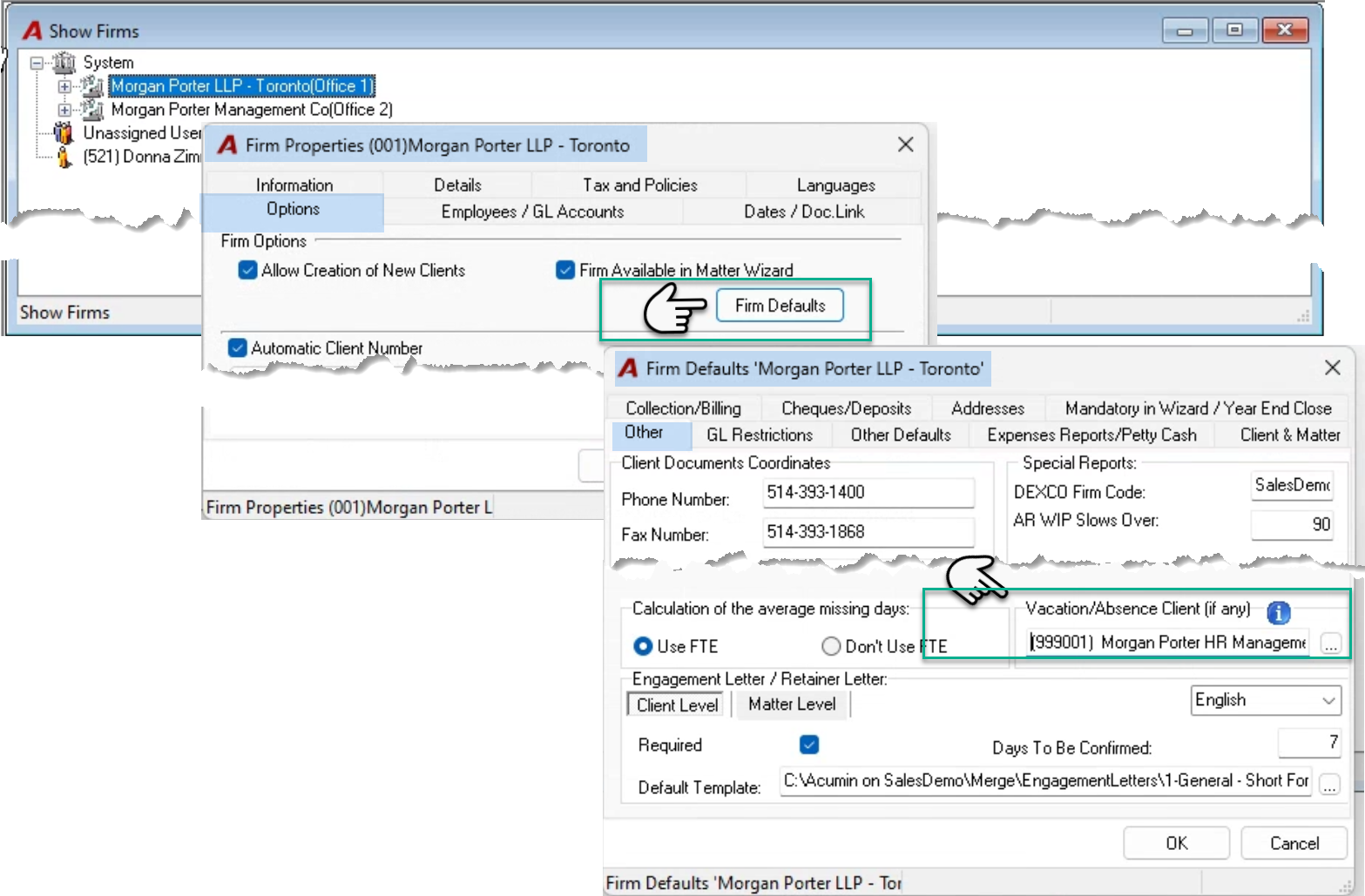
Non-chargeable time member-specific matters designed to track personal absences and planned time-off are created within a special internal firm client created for this use-case and assigned to the “Vacation/Absences Client” field found in the “Other” tab of the firms defaults form of the properties for the main firm (001).
Internal Client: Create a client with the name of the firm followed with “… – HR Management Non-Productive Time”. Although the client will be assigned the next client number, override it to an easy-recall number.
Most organizations create member-specific matters that are restricted to a limited list of allowable members to limit exposure and optimize privacy and associated to a coding task-set to control the type of time recorded.
Create a restricted matter, matter type “Personal” for each member in the organization. Include the member as the specified member in member properties and the allowable member on the allowable list. If possible, use the member code as the matter code. Assign the matters to an area of practice “Human Resource Management”.
Create and assign an internal task set that includes a limited number of time codes and possibly no expense codes to be used with these types of matters. As part of the structure, firms create several activity-specific time codes to breakdown time-off into logical segments like vacation and sick days.
Consider setting the HR Manager and HR positions holders (if any) into the various matter level roles for additional reporting dimensions beyond the timekeeper (working member).
Timekeepers will enter they non-productive time into the HR Matter. They can record and post future dated time to this type of matter, reflecting planned time-off on their pace-to-target and hours worked measured.
Other Points to Consider
Non-Chargeable Time Presentation Options
Set the hours worked dashboard to present the chargeable hour investments based on the firm’s priorities and vision. Once set-up, the graph will offer key groupings as well as total chargeable equivalent values (if used).
Chargeable Equivalent
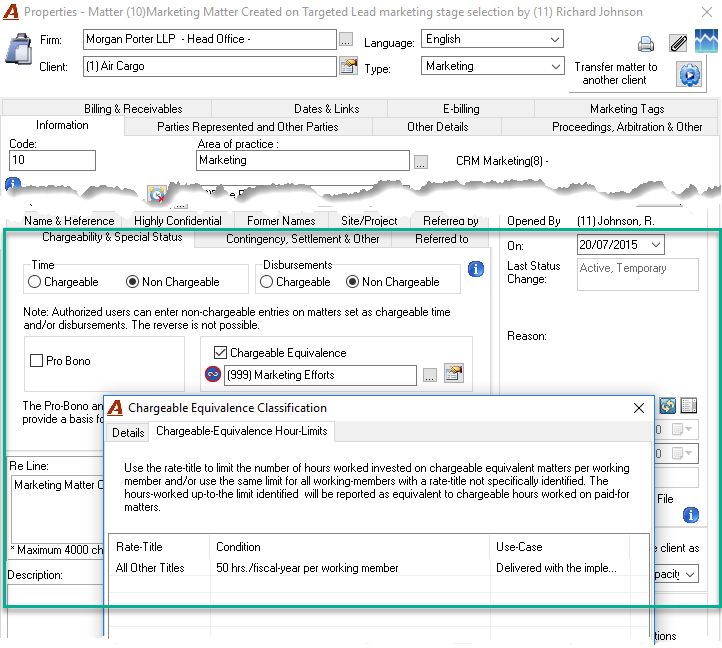
Non-chargeable time matters can be classified as pro-bono and/or chargeable equivalent. The chargeable equivalency can be unlimited and applicable to all the non-chargeable time recorded or limited to a pre-set value per matter based on rate-title.
Other Set-up Considerations
Naming and Coding Convention
Member-based Matters: Name the matter the members’ last name, first name – the activity; Area of practice or practice group matters should bear the same name as the corresponding dimension - followed by the activity.
Manually override the matter code in consideration of existing code logic, for example to equal the member code plus the activity which in this example as ben set up as area of practice.
Example: Create the professional development and continuing education activity as an area of practice code 2. In this case the matter for James P. Stewart (member code 1233) with a name and re: line = to: “Stewart, James - Professional Development and Continuing Education” and a matter code = to “12332”
Set-up considerations
For member-based matters - select the Matter Type = Personal or Marketing (depending on the area practice). This will open an additional field in matter properties where you will be able to link the matter to the member. The field name is labeled “specified member”.
Assign the corresponding non-chargeable activity area of practice to the matter. Set the time and disbursements as non-chargeable. Consider using WIP limit rules to apply budgets and hard limits. Consider the impact of the non-chargeable equivalency options offered.
Set-up a Marketing Matter for the Firm:
In addition to creating recommended marketing matters per practice groups or offices to track practice group specific or office activities respectively for activities outside of member specific marketing endeavours, the law-firm client may wish to create a marketing matter for firm wide activities. In this case, although the matter type marketing would be suitable and should be used, the specified member field should be left blank.
Use of Matter-Level Roles
Consider using the matter level roles as additional reporting dimensions (e.g., for the marketing matter the marketing director may be consistently set-up as originating member while the member him or her-self would be the member assigned). In addition, if required considered using the restricted matter logic to limit access this member-based matters to limit access to matter details.
Committee Work
If number of committees is significant and the law-firm-client consider each a valuable reporting dimension, then create an area of practice “Committee Work”. To be able to assess the amount of time spent per committee, the committee work matter structure should include a non-chargeable matter per committee. In this case each matter should be coded in a number sequence outside of the formula used for the member specific matters.
Consider setting the committee chair and other committee position holders into the various matter level roles for additional reporting dimensions beyond the timekeeper (working member).Users will be asked to enter committee work time and or expenses into the committee work non-chargeable matter structure.
Management and Accounting of Non-Chargeable Time
Users of these processes and reporting opportunities may decide to reclassify the non-chargeable time from “unbilled” to “removed” - the equivalent of unbilled time write-off for chargeable entries. The timing for removing these entries is dependent on how the firm manages and reports these entries. Typically, firms opt to keep the non-chargeable records as unbilled for a couple of fiscal years.
Accounting Impact on Non-Chargeable Time and Disbursement Entries
Time: Whether the law-firm client subscribes to a journalized model for time entries or not, as non-chargeable time is not WIP and has no accounting impact, only a management reporting measure can assess opportunity costs.
Disbursements: Non-chargeable disbursements are unbilled disbursements (assets); therefore they are journalized into firm defined GL Accounts (expense and recovery) which are established within disbursement code properties.
Through the application of mapped disbursement codes, third party disbursements charged to non-chargeable disbursement matters are correctly accounted for in the GL structure.
In disbursement code properties, the authorized user establishes the relevant GL account code where the disbursement entry should be journalized if the charge is made to a non-chargeable disbursement matter or if the disbursement code is by default non-chargeable.
Writing-off Disbursements: Non-chargeable disbursements were never UBD (assets), therefore they should not be considered bad debt expense. On removal (write-off) of the non-chargeable disbursement, the GL operations affect the same GL accounts as on posting in reverse.
Note: The impact on the Income Statement will depend on how the affected GL accounts are mapped to the disbursement code.
RELATED DOCUMENTS:
General Ledger - GL Operations - Non-Chargeable Entries