.png)
Overview
Reported cash and write-off allocation refer to the end result when allocating payments received or fees receivable written off to members, based on the fee allocated to those Members participating on the related invoice.
When allocating payments received to members, Acumin relies on the principal of conservatism - based on accepted general application across Law Firms for the last 35 years; resulting in partial payments being applied in the following order;
-
To sales tax invoiced;
-
To disbursements, and;
-
To fees.
As a result, when a subsequent AR Write-off follows it is possible to have recovery of sales taxes which will generate a pick-up of additional cash allocation for participating members.
Cash Received (Payment) Allocation Details
Based on the principal of conservatism, when a partial payment is received the application will automatically cover all the out of pocket invoice components (namely Sales Tax and Disbursements) before allocating any cash (receipts) to fees and corresponding participating members. This ensures that no individual is compensated before the Law Firm covers its responsibilities (sales tax and disbursements). Of course once partial payments are applied to sales tax and disbursements, any subsequent payment on the same invoice will be considered as payment of fees and allocated accordingly.
The details of the calculation are as follows:
-
On creation of the payment the application establishes the upper limit so as not to exceed the unpaid portion of the Invoice;
-
Once the payment is posted, it is automatically allocated;
-
First against invoiced amounts, namely sales tax, disbursements and fees – in that order, and;
-
The portion of the payment (receipt) allocated to fees (if any) is then allocated to those members who participated in the invoice, based on their final fee allocation.
-
Authorized users have the option to override the default cash receipt allocation.
AR Write-off Allocation Details
A further refinement of the allocation process ensures that any Sales Taxes recovered through the process of AR Write-offs or Credit Notes are reallocated back to cash (payments) applied to fees resulting and in their subsequent allocation to corresponding participating members.
The details of the calculation are as follows:
-
On creation of the AR Write-off or Credit Note the application will automatically propose that the latter be applied to fees and related sales tax if any;
-
Also on the creation of the AR Write-off or Credit Note, the application establishes the upper write-off / credit note limits not to exceed the unpaid portion of the Invoice;
-
Within this upper limit the user is further limited to the three components of the invoice, where an AR Write-off or Credit Note cannot be applied against fees, disbursements or sales tax in excess of the amount originally billed (second limit);
-
In view of the default- to create the AR Write-off against fees and related sales tax - users must specifically select the object(s) – disbursement code or sales tax rule; in order to allocate the AR Write-off to disbursements and/or sales tax. In this case, the user will remain limited to the value billed of the selected object (second limit);
-
Once the AR Write-off or Credit Note is posted, based on the final selection made (to fees, disbursements and sales tax), the Cash (Payment) Allocation will be calculated to reflect any net additional Fees collected (recovered) resulting from the recovery of sales tax triggered by the AR Write-off or Credit Note.
Note: The allocation of AR Write-offs and/or Credit Notes and the resulting allocation of fees in response to the recovery of sales tax will have a transaction date equal to the GL date of the AR Write-off or Credit Note, thus balancing to the sales tax reduction to sales tax billed for that filing period.
Conclusion
We recognize that the timing of the allocation in the case of partial payments is in accordance to the principle of conservatism ensuring that individuals compensated based on cash received are not prematurely compensated for what later may become a Write-off or Credit Note.
Example
-
When a partial payment is received, it must be first allocated amongst fees, disbursements and sales tax. Using the principle of conservatism, partial payments are allocated against sales tax and disbursements, with any amounts remaining then allocated to fees. The portion allocated to fees is further allocated to members as cash (receipt) allocation based on their participation in the related invoice.
-
When an AR Write-off is later processed, the original amount of sales tax is no longer true as at the date of the AR WO. The application must reflect the new reality reducing the allocation of the partial payment of sales tax as at the AR Write-off date and applying this value against un-allocated amounts to fees. Note: This reallocation must balance to the DR to sales tax billed in amount and date. Furthermore, this is a reallocation of the cash receipts applied to the original value of the sales tax, now that the value has been reduced.
|
Items |
Date |
|
Fees |
Disb |
Tax |
Total |
|
|---|---|---|---|---|---|---|---|
|
Invoice |
February |
|
100 |
50 |
10 |
160 |
The $100.00 is allocated to various members using the fee allocation formula of the firm |
|
Payment |
March |
|
20 |
50 |
10 |
80 |
Only 20.00 is then allocated to members as cash receipt allocation. This remains true until an AR Write-off is processed which reduces the sales tax from 10.00 to 5.00 |
|
AR Write off |
May |
Recovery of sales tax |
5 |
|
-5 |
0 |
Originally $10.00 of the partial payment was allocated to sales tax, however, due to the AR WO the new sales tax is $5.00, therefore the remaining $5.00 originally applied to sales tax must be reallocated to fees. |
|
Note to reader** |
|
|
25 |
50 |
5 |
80 |
If we would have applied the Write-off first, the amount allocated to fees would have been the amounts reflected on this row. Please note that without the allocation of the AR recovery, the allocation of cash and AR WO would not balance with the GL nor sales tax reports. In other words, there are $5.00 which the firm will receive as a reduction in taxes billed which must be allocated to fees in order to balance. |
|
AR Write off |
May |
Impact on bad Debt |
75 |
|
5 |
80 |
The AR WO of $80.00 is processed against fees and sales tax. The fee portion is further allocated to members representing a further breakdown of the bad debt expense by member based on fee allocation (typically part of the line-up of Key Performance Indicators for a member). |
Conclusion
-
The AR Write-off produces a GL transaction against Bad Debt Expense for Fees and/or Disbursements as well as Sales Tax Billed;
-
The Bad Debt Expense for Fees Billed is further allocated to members based on participation in the original invoice;
-
The recovery of the sales tax (the DR to sales tax billed) represents a reduction to amounts owed to the government, therefore if we only were to process the AR Write-off for the accounting period, we would in fact receive a payment (reimbursement) of sales tax billed (sent to the government based on the original date of the transaction).
-
The recovery of the sales tax applied to fees is therefore a benefit and will be allocated to members based on their participation on the original invoice on the date of the AR Write-off. We cannot allocate this recovery as bad debt expense as it truly represents a recovery of amounts received and applied to a sales tax value which is no longer true.
How to Process a Cash (Payment) or AR Write-Off Allocation Override
-
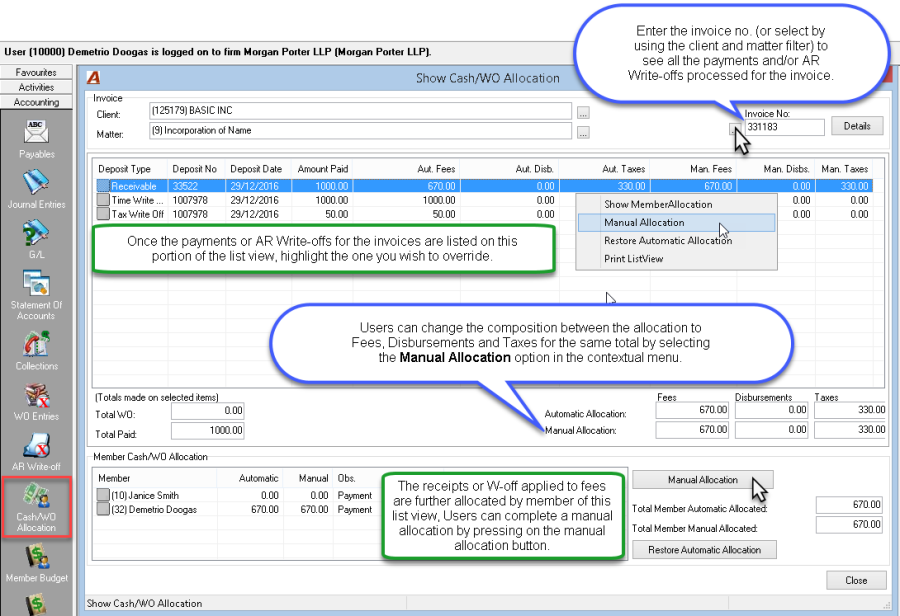
Select the invoice;
-
Highlight the payment or AR Write-off you wish to modify;
-
Modify the allocation between fees, disbursements and sales tax (if needed) by selecting the Manual Allocation option in the contextual menu, and / or
-
Modify the member composition of the allocation of payments or AR Write-off against fees through the manual allocation option presented.
Note: The allocation override for members is limited to the amount allocated against fees.
How to Process a Credit Note Allocation Override
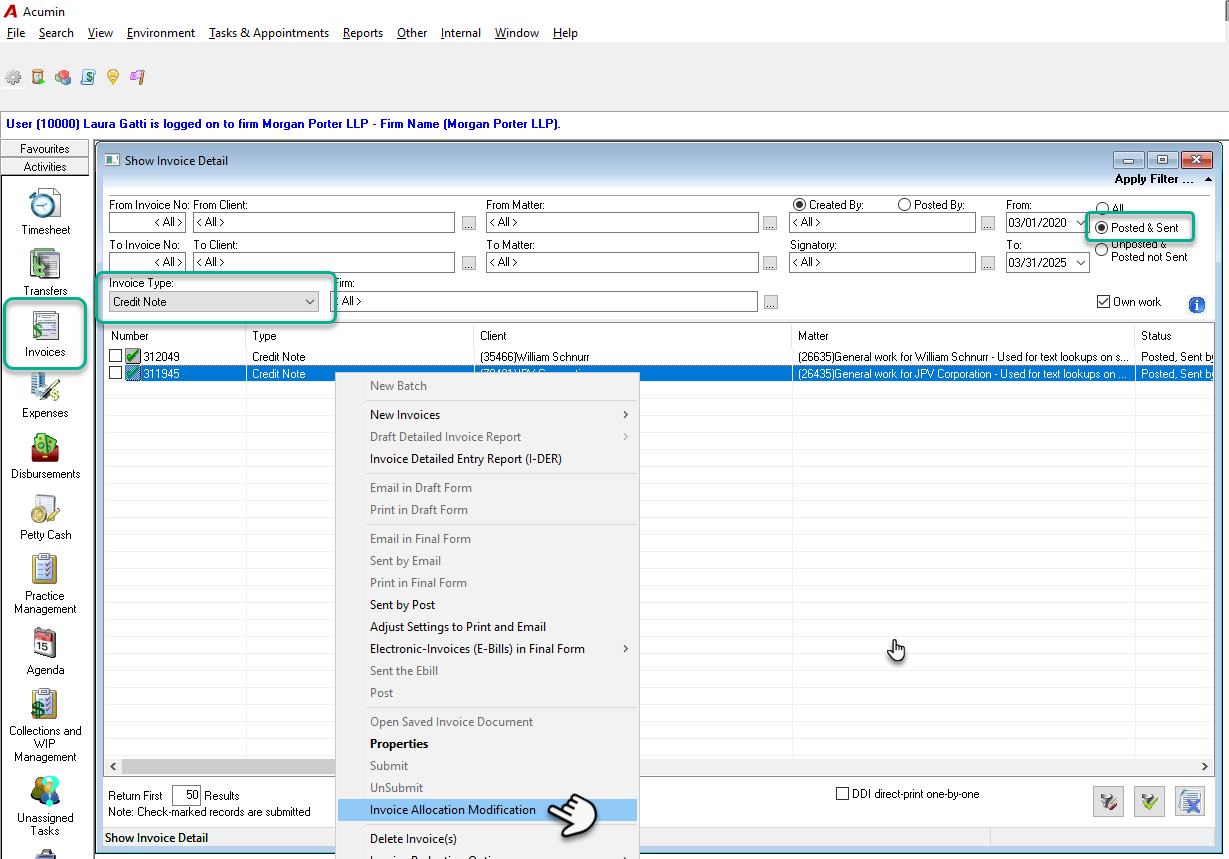
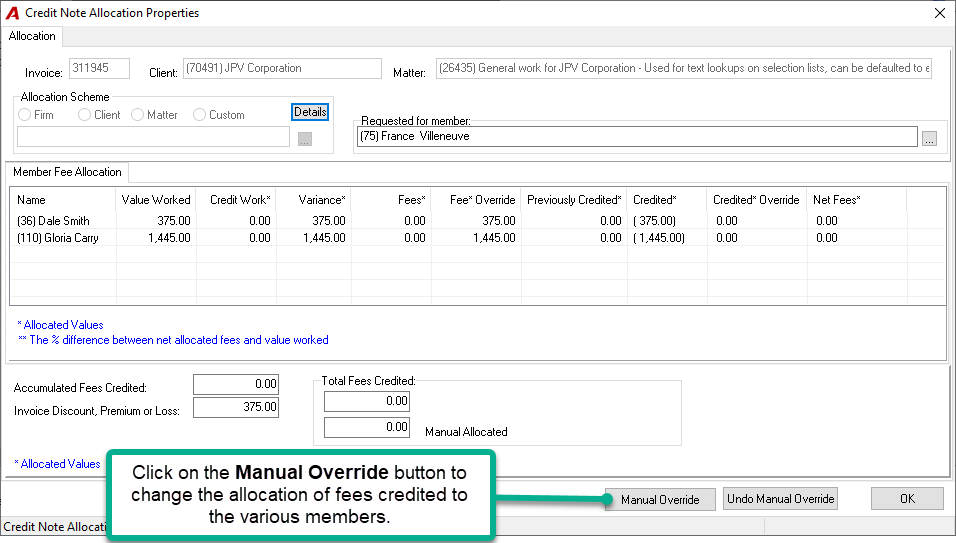
Note to Reader
The document referred to as CRA – Bad Debt Tax Application Paragraph 231.1 is from Revenue Canada and explains how to proceed with Tax Calculations when Bad Debt Write-offs are involved.
It mentions that we can claim as Input Tax Credit, the Sales Tax proportionately:
ITC = Total Tax Remitted x Total Value of Bad Debt (all in)
Total Value of receivable (all in)
As it relates to Acumin, the calculation of the ITC or sales tax recovery on a write-off (as described above) is not directly related (or unrelated) to Acumin's cash allocation concepts. They are parallel concepts which arrive at the same end result.
In conclusion, once the invoice is at zero balance (fully paid, fully written off, fully credited or due to a combination thereof) the resulting cash allocation is as per CRA.