.png)
Fully Paid Invoice – Payment Reduction
Use Case
This type of reversal is used when there is a requirement to issue a credit note on an invoice that has an insufficient receivable balance or is paid in full.
Summary
Before the credit note can be issued, the user must reverse the payment for the invoice to create a receivable balance, at which point the credit note can be issued and posted. Any unapplied overpayments as a result of the transaction is either refunded to the client in the form of a quick payment or transferred to trust.
Process
0.00 Deposit
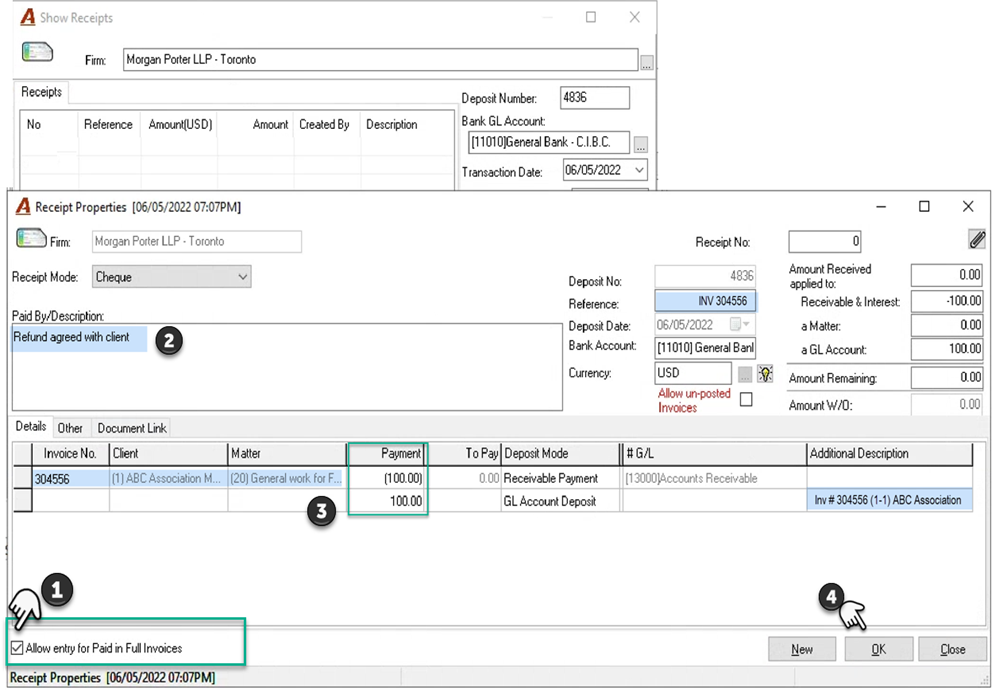
Create a 0.00 value general deposit slip request (yellow book). Once on the receipt form checkmark the option to allow the selection of a paid invoice (bottom left).
Complete the upper section of the receipt form. Include in the description content with the reason for the payment reversal and enter the invoice number affected in the Reference field. This will provide a path when searching for the information.
Complete the distribution. Enter the invoice number in the Invoice No. cell. Tab to the “Payment” field and enter amount of the refund as a negative value. On tab out it will be presented in brackets. This will create a credit to the AR subledger to allow you to process the credit note.
Arrow down and make a new row, enter the amount of the refund as a positive value and tab to select a GL account – for example miscellaneous receivables. Tab to the additional description field and add the client and matter codes, client name and invoice number as this will add the relationship to the invoice to the GL details in case you need to reconcile the content of this account. This operation will create a debit in the miscellaneous AR account to allow you to create a general cheque to refund the client or transfer the funds to trust.
Press OK to exit, complete the as a bank deposit slip (green book) and post.
Credit Note
To clear the new AR Balance, generate a credit note. Once posted, the AR balance for the client should be back to 0.00.
Refund
Generate a quick payment against the miscellaneous receivable GL account where the positive receipt was applied, OR generate the quick payment in the form of a general cheque payable to the firm in trust to transfer the funds into the client’s trust account for future use against future invoices.
Dates
For a best outcome on measures, metrics, and audit trails, all these transactions should be currently dated.