.png)
Scope and Purpose
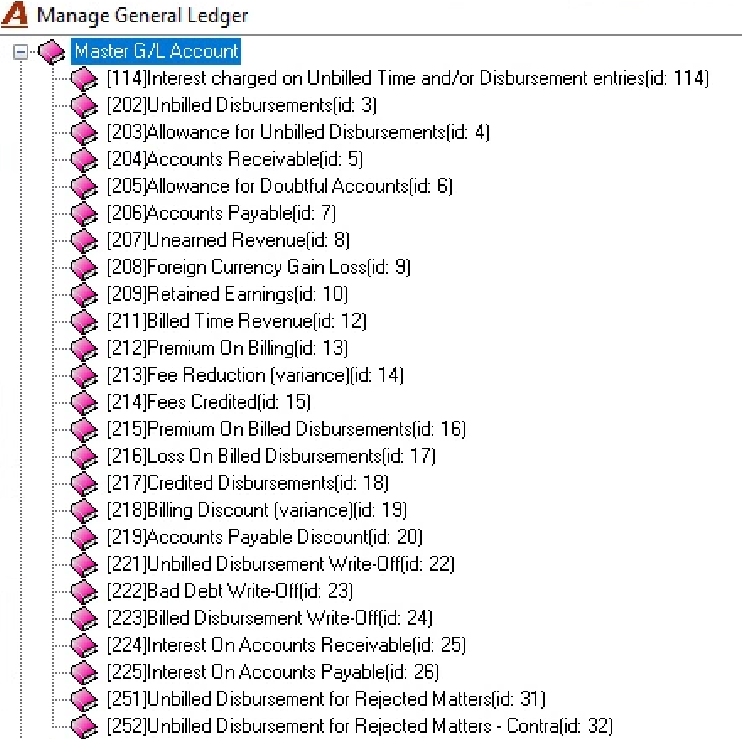
The purpose of master accounts is to control the type of GL operations resulting from functional objects like invoices or deposits. The scope of master accounts applies to all functional objects that generate GL operations. Banks and trust are also special accounts; however these are not functionally controlled.
Master GL Accounts
Many organizations change the code and name of master GL accounts to fit the firm’s chart of accounts and better represent the order when generating the trial balance. These changes do not compromise their integrity. For ease of reference, they are recognized through the id shown after the name (tree view format). Master accounts should not be used for non-system operations, journal entries or for consolidating converted control account balances.
In a multi-firm environment, whether each profit-center (firm) has its own chart of accounts, or they all share one, the master accounts must remain available to all firms included in the system.
|
114 |
Interest on Unbilled Time and/or Disbursement entries [id 114] |
Revenue |
|
202 |
Unbilled Disbursements [id 3] |
Asset |
|
203 |
Allowance for Unbilled Disbursements [id 4] |
Contra-asset |
|
204 |
Accounts Receivable [id 5] |
Asset |
|
205 |
Allowance for Doubtful Accounts [id 6] |
Contra-asset |
|
206 |
Accounts Payable [id 7] |
Liability |
|
207 |
Unearned Revenue [id 8] |
Liability |
|
208 |
Foreign Currency Gain Loss [id 9] |
Expense |
|
209 |
Retained Earnings [id 10] |
Capital |
|
211 |
Billed Time Revenue [id 12] |
Revenue |
|
212 |
Premium On Billing [id 13] |
Revenue |
|
213 |
Fee Reduction (variance) [id 14] |
Revenue |
|
214 |
Fees Credited [id 15] |
Revenue |
|
215 |
Premium On Billed Disbursements [id 16] |
Expense |
|
216 |
Loss On Billed Disbursements [id 17] |
Expense |
|
217 |
Credited Disbursements [id 18] |
Expense |
|
218 |
Billing Discount (variance) [id 19] |
Contra-revenue |
|
219 |
Accounts Payable Discount [id 20] |
Revenue |
|
221 |
Unbilled Disbursement Write-Off [id 22] |
Expense |
|
222 |
Bad Debt Write-Off [id 23] |
Expense |
|
223 |
Billed Disbursement Write-Off [id 24] |
Expense |
|
224 |
Interest On Accounts Receivable [id 25] |
Revenue |
|
225 |
Interest On Accounts Payable [id 26] |
Expense |
|
251 |
Unbilled Disbursement for Rejected Matters [id 31] |
Expense |
|
252 |
Unbilled Disbursement for Rejected Matters – Contra [id 32] |
Expense |
Master Accounts Use Case
To maintain the integrity of the database, the use of the master accounts must be limited to the function that triggers the GL operations it includes. This ensures that only permitted functional processes can add content to the affected GL account, so the functionally driven GL operations can be audited and balanced against the functional transaction that triggered it. As a result, journal entries should not be posted against any master account.
If there is a desire to journalize amounts against a master account, create a regular GL Account and assign it to the same financial statement group as the referenced master account. For example, instead of posting a debit to “Accounts Receivable [id5]” – create a regular GL account “Accounts Receivable for JE” and post a debit to “Accounts Receivable for JE”.