.png)
Fee Allocation Report
Scope and Purpose
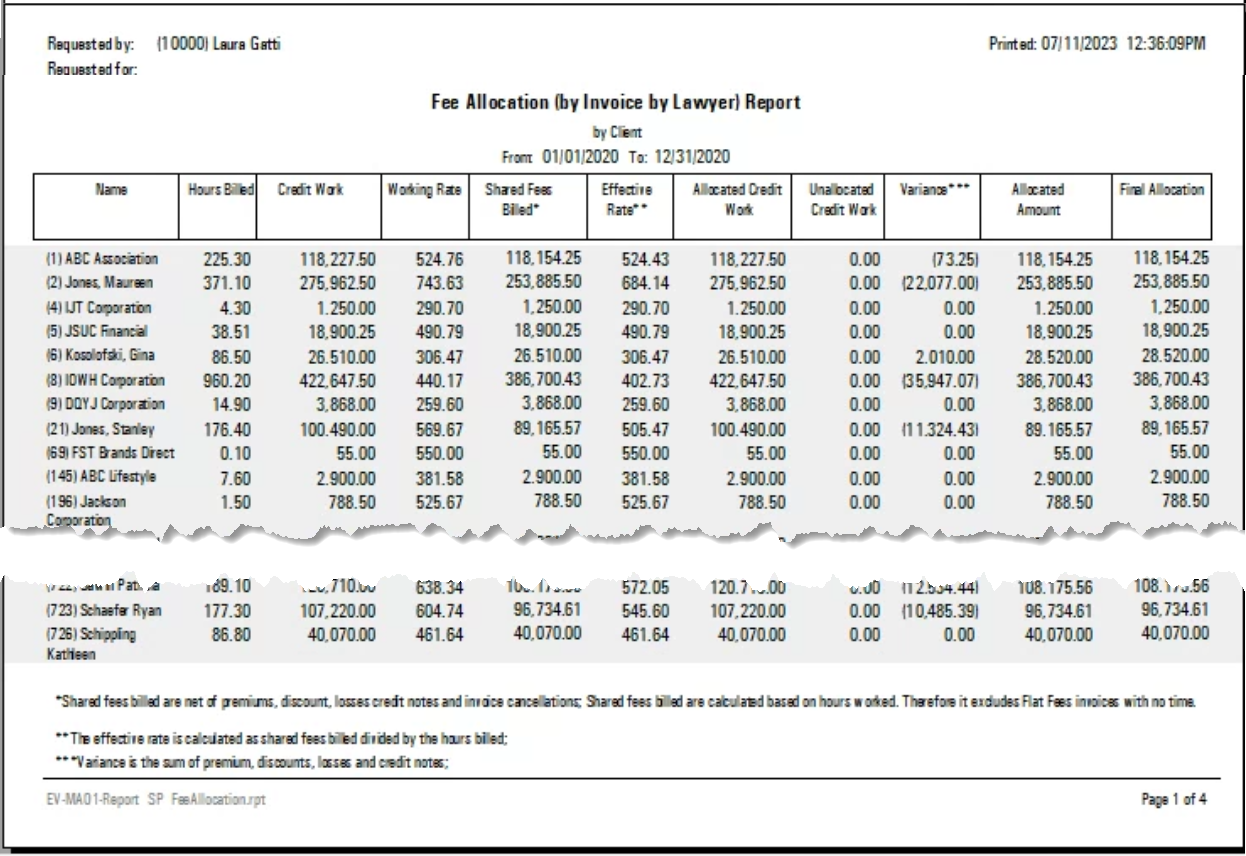
The purpose of the fee allocation report is to provide visibility of how the net fees billed are applied to the “Allocated-to Member”.
The scope of the report extends across multiple reporting attributes including working member, client and/or matter role or shareable role, the member’s practice group, the client’s industry, and/or the matter’s area of practice. The measures presented include hours billed, their corresponding credit work, working and effective rates, formula-based fee allocation results, and any fee allocation manual overrides completed for the invoice or credit note.
Highlights
Working members includes timekeepers - members that have time billed whether they have final fee allocation or not; as well as allocated-to members – members with final fee allocation but without time worked.
The fee allocation by invoice by lawyer has as the lowest level of detail the working member.
The report includes measures detailing the impact of the fee structure for billed work (credit work) during the period selected, along with resulting working rates and effective billing rates.
Most often executed by working member, this report includes the member’s credit work, the shared fee measure, as well as the formula based and final allocated fee measures after a manual fee allocation decision.
Allocation schemes (formulas) are firm created and defined. Each firm has the potential for an unlimited number of allocation schemes, each comprised of one or more allocation rules which include non-timekeeper attributes. As a result of, the working member bearing the allocated-to value is not necessarily always the timekeeper that earned the credit work at working rates.
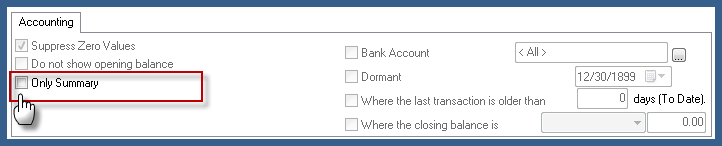
The “only summary” option included in the “Additional” tab, can be applied to summarize to the lowest group level selected in the “details” tab.
Executed by member role, the report is often generated with its lowest level of detail - the allocated-to member(s) involved in the invoice. In this case, the allocated-to members list within the affected invoice.
Executed by working member (allocated-to member), the detail level results are presented by invoice, therefore within this context the use of the “only summary” option with the matter as the lowest level of detail is often a favoured presentation for an easier read.
Fee Allocation by Invoice by Lawyer Report
Access
From the main menu select “Reports – Management – Allocated Shared Fees Billed, Credited, Collected, Written-off – Fee Allocation – By Invoice By Lawyer”.

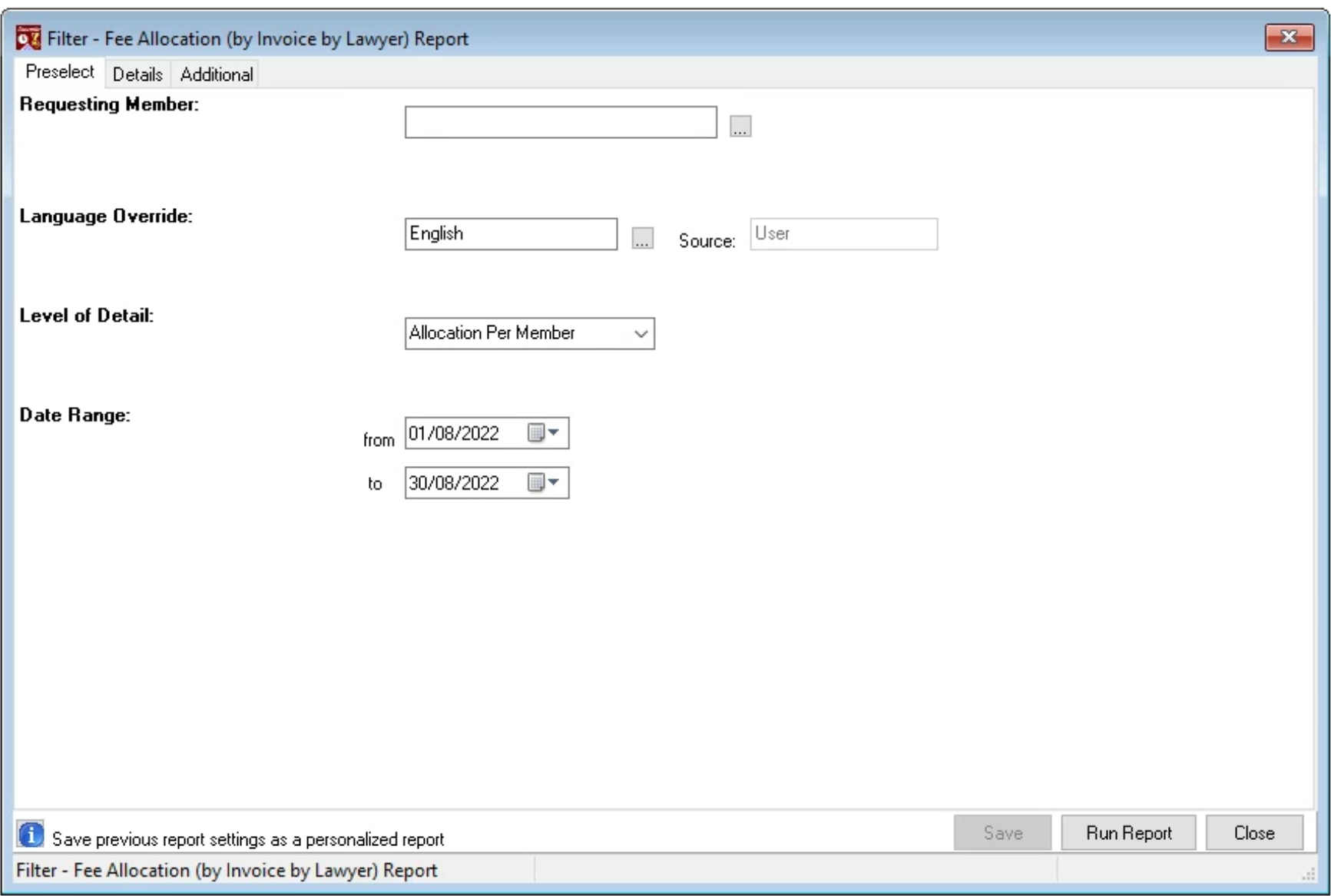
The Preselect Tab
Select the date range for the reporting period.
The Details Tab
Un-select the default reporting dimensions not needed for the intended presentation outcome.
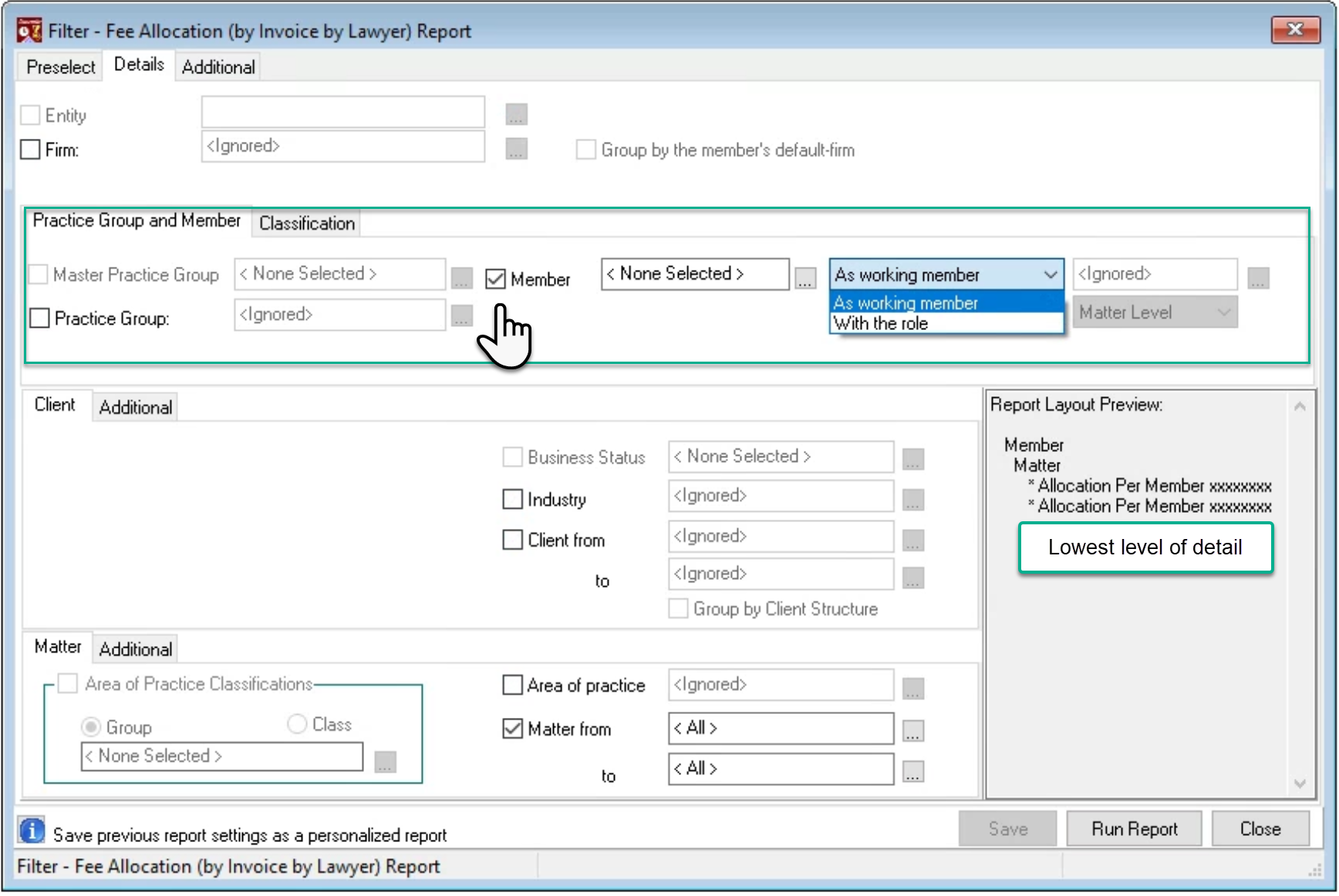
With the role:
If executed by client or matter level role, all the measures are based on the total values for the invoice grouped into the reporting dimensions chosen, attributed to the member assigned to the role selected.
Working Member:
If executed by working member, the shared fee measures are pro-rated based on the timekeepers’ credit-work and the allocated fee measures are based on the applied allocation formulae or manual override (if any) to the allocated-to member.
To breakdown the results into the report’s lowest level of detail – the allocated-to member – do not select the “only summary” checkbox option found in the “Additional” tab. If the report is summarized, it will provide as the lowest level of detail the lowest grouping dimension selected.
The Additional Tab
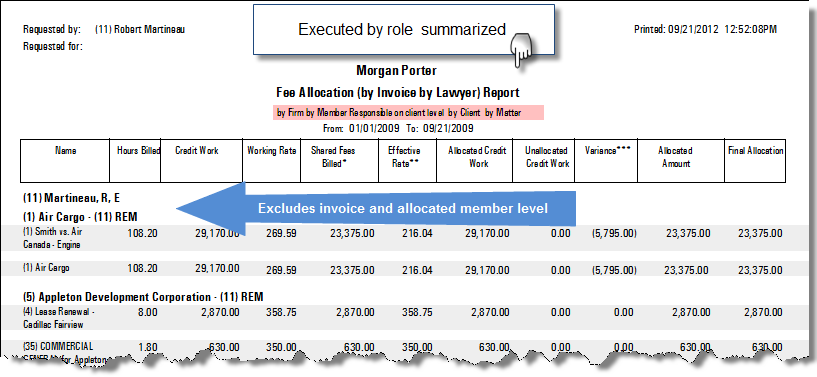
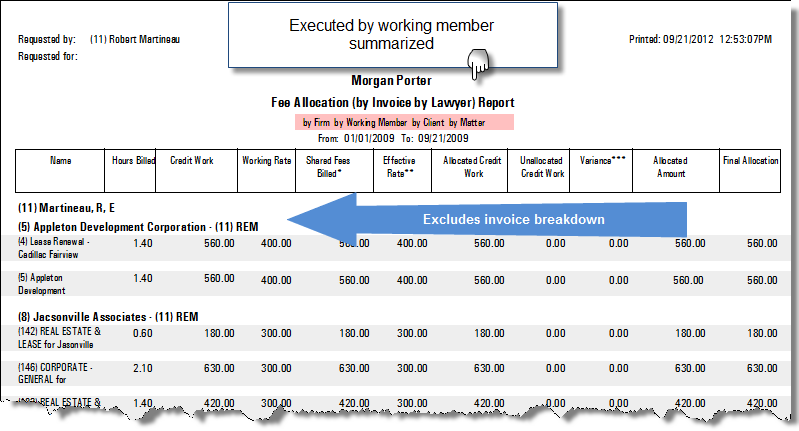
Use of the “only summary” checkbox option found in the accounting sub tab eliminates the breakdown by allocated-to member and provides the results by the lowest group selected in the “Details” tab.
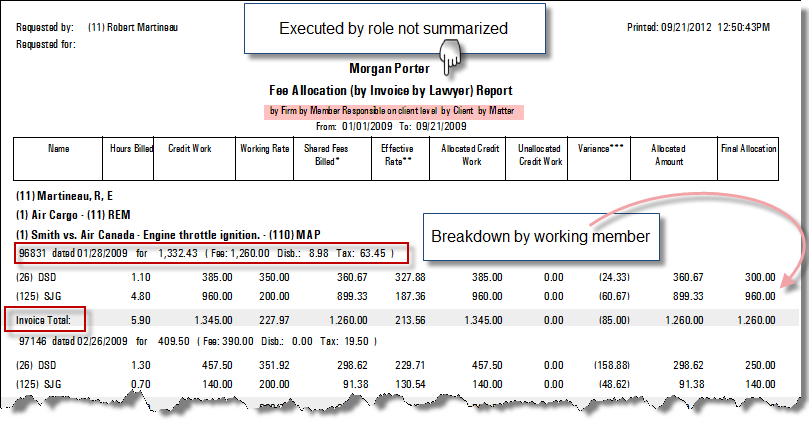
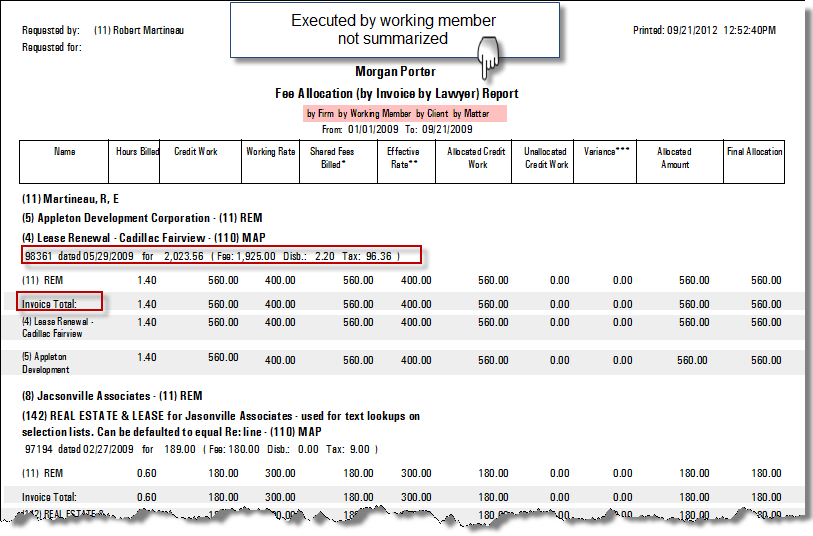
If the report is executed by working member and not summarized, the report will show the working member measures broken down by invoice. If the report is executed by role and not summarized, the report will show the role-based measures broken down by invoice , by working member (allocated-to member).
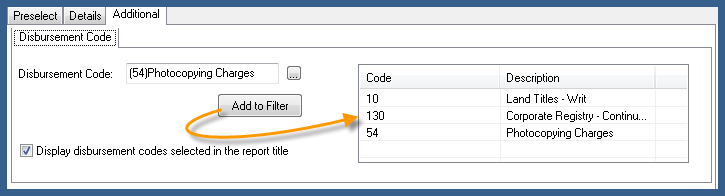
The additional tab also offers the authorized user the ability to further filter the report results to only include fee measures for invoices that include specifically selected disbursements.

On “Run Report” the Page Breaks & Sort Order form is launched.
The Page Breaks & Sort Order form
Users can add a page break for a grouping dimension used, reset the page numbers after each break, and/or change the sort order presentation of grouping dimensions from numeric by code (123) to alphabetic (ABC) and/or from ascending (asc.) to descending (desc.).
Users can also change the perspective of the report by reordering the groups. For example, instead of executing the report by industry by Area of Practice by client, the order could be modified to by Industry, by Client, By AOP.
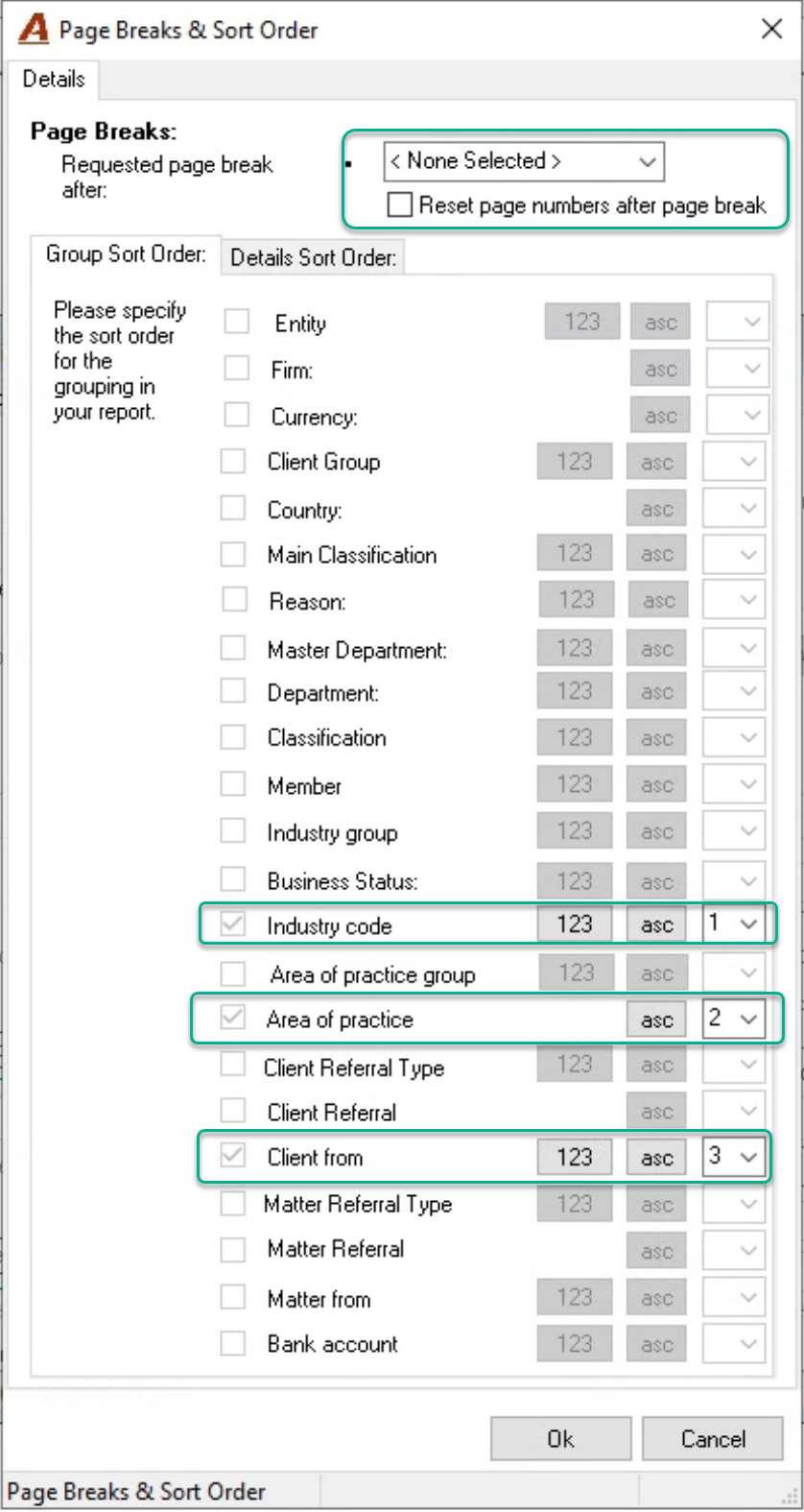
Press OK to generate the report.
Measures
Definitions
Hours Billed: The hours worked included in the invoice
Credit Work: The worked value of the hours billed - hours billed multiplied by the applicable rate as at the entry transaction date.
Working Rate: The average rate worked at. Credit work divided by hours billed.
Shared Fees Billed (*): Fees Billed, net of gains (write-ups), losses (write-downs), discounts and fees credited, shared on a pro-rata basis in context of earned credit work included within the invoice. The measure is calculated using the invoice, credit note and/or cancellation date, respectively.
Effective Rate: The calculated rate at which the work is billed independent of allocation decisions. Shared fee billed divided by hours billed.
Allocated Credit Work: The value worked - credit work - allocated to the allocated-to member by the allocation schema applied to the invoice.
Unallocated Credit Work: Re-allocated value worked for working members whose work is not attributed to them by the allocation rule applied, but instead is attributed to someone else. The unallocated credit work not granted to the working member is re-allocated to others by the allocation rules set in the allocation schema.
Variance: The sum of fee overrides - write-ups and write-downs, discounts and fees credited, net of invoice and credit note cancellations, allocated in context of how the schema is set to manage timekeeper specific gains and losses. The measure is calculated using the invoice, credit note and/or cancellation date respectively.
Allocated Amount: Fees Billed, net of write-ups and write-downs, discounts and fees credited, allocated to the allocated-to member using the allocation schema applied to the invoice. The measure is calculated using the invoice, credit note and/or cancellation date respectively and it does not include the effect of manual fee allocation overrides.
Final Allocation: The final allocation granted through the allocation schema applied to the invoice or because of a manual fee allocation override.
Points to Consider:
Credited Fees: Measures resulting from credit notes will show in negative.
Credit work cannot be transferred. The value of time worked included in an invoice, is not a value that can be allocated or transferred to someone else.
Working members includes timekeepers and allocated-to members. The working member for this report includes members that have time billed (timekeepers) whether they have final fee allocation or not, as well as allocated-to members that have final fee allocation without any time worked.
Allocated-to members are members that have allocated-to values because of the allocation schema used, or because of manual fee allocation modifications (take from one lawyer and add to another). It is possible for an allocated-to member to not have time billed within the invoice; in which case they will not have hours billed nor a shared fee billed value.
The initial invoice value is the credit work included in the invoice (the total value worked). This fee value is often adjusted through billing adjustments like fee overrides, write-downs to 0.00 etc., and/or through the application of discounts or premiums resulting in a net fee billed position that is potentially more or less than the initial total credit work.
The total net fees billed is the value allocated to the allocated-to member based on the attributes of the allocation schema applied to the invoice. For example, if the allocation schema for regular matter invoices is created to allocate the net fees billed based on the timekeeper's credit work, then the allocated fee value calculated by the formula will be proportionate to the timekeeper's credit work.
Allocated values are not always proportionate to shared fees billed. Due to the many options and attributes of the allocation schema, and the ability to have many allocations schemas in use, the formula-based allocated values may not actually result in a proportionate allocation of net fees billed.
Credit-work-based allocation schemas: If a credit work-based allocation schema includes the option to have member/entry specific gains or losses applied directly to the affected timekeeper to measure member specific efficiencies, when the invoice preparer applies fee overrides directly to an entry or a member, the allocated results would not be proportionate based on credit-work.
The No-time invoice is not expected to have credit-work; therefore, the allocation schema options and attributes for this type of invoice are limited to non-credit work alternatives like matter or client role. As a result, the total allocated fee measure for the organization may not equal the total shared fee measure. Fees for no-time invoices are considered in the allocated value but excluded from the shared fees one.
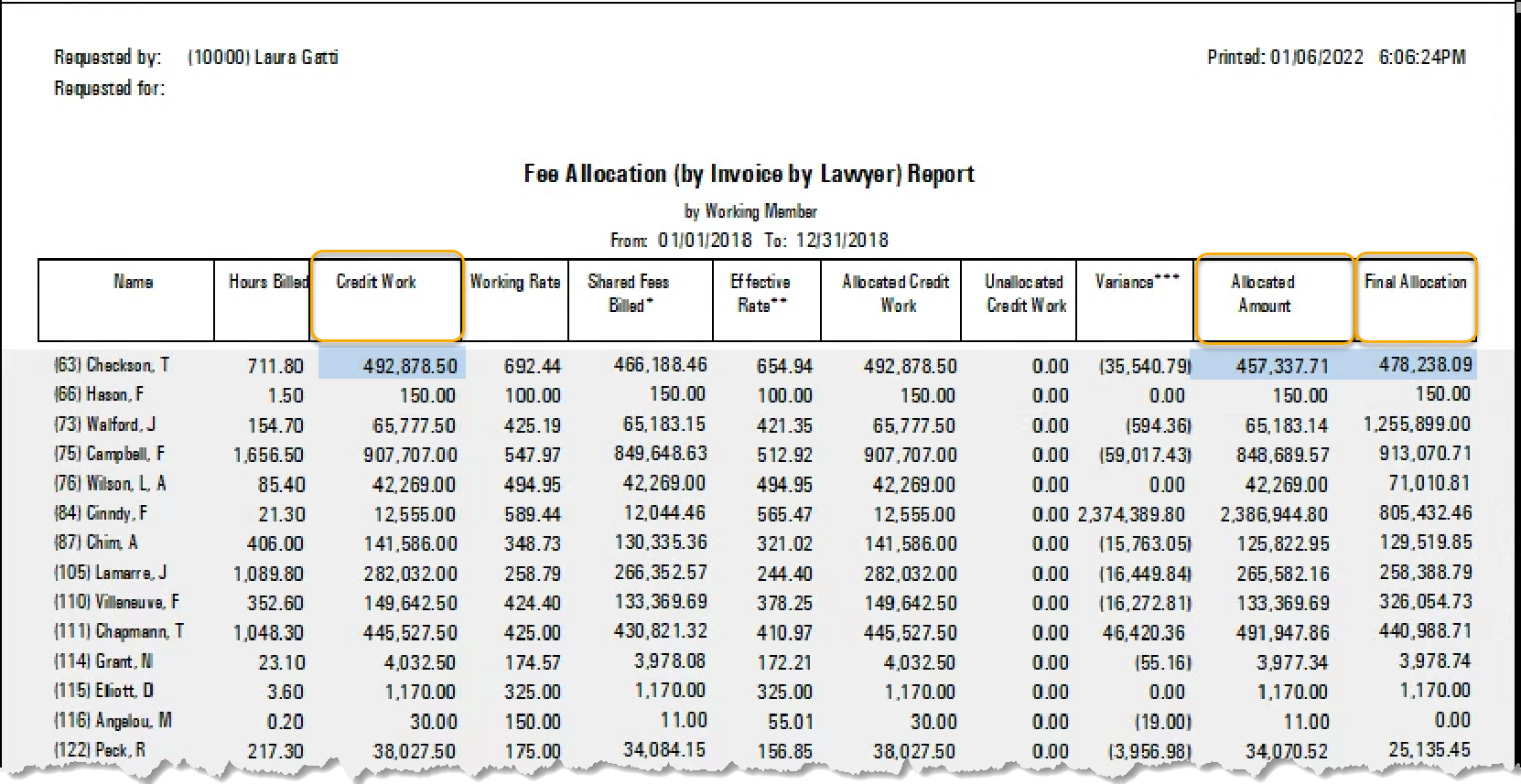
Final Allocation: As authorized users can modify the formula-based fee allocation results, causing the re-allocation of fees billed from one member to another, a difference between the formula-based fee allocation and final allocation shown on this report when executed by working member, shows that the allocation was manually modified.
Report Outputs:
Reports by matter can be executed without the client group. In this case the client-matter number will be presented together separated by a hyphen followed by the matter name.
Example by role not summarized - measures for the invoice are presented by allocated-to member.
The report is by role summarized therefore it excludes the breakdown of the measures by invoice by allocated member.
The report is by working member not summarized therefore it includes measures at the invoice level.
The report is by working member summarized therefore it excludes the invoice level breakdown.
The report is by working member summarized by member.
The report is executed for one client summarized by matter
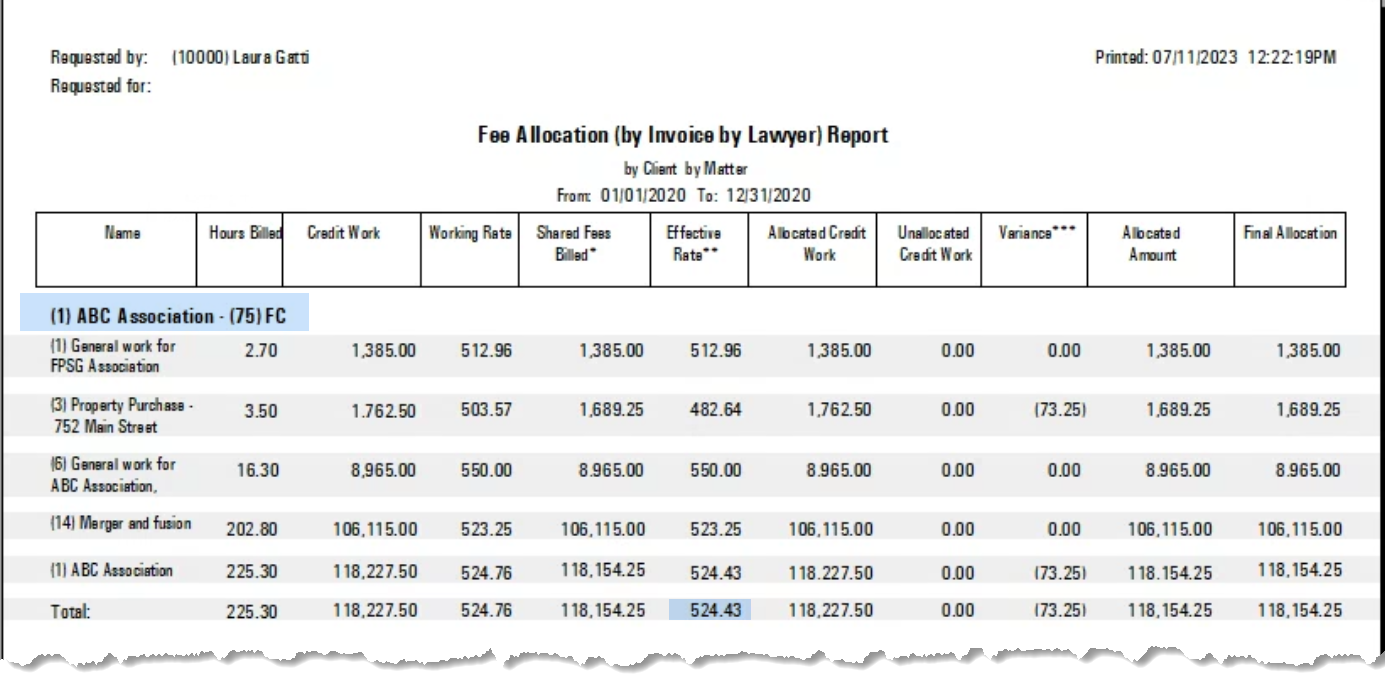
The report is executed summarized by client