.png)
Scope and Purpose
The purpose of the modification limits is to limit permitted functionality based on value.
The scope of this document extends to modifications limits for billing and unbilled entry write-off processes.
Context
Firms where transactional control is based on exceptions beyond a certain threshold, authorize their users to execute unbilled entry write-offs or the posting of invoices in consideration of limits set per member. Once the transaction result exceeds the threshold the permitted functionality is secured for someone else to finalize.
Modifications Limits
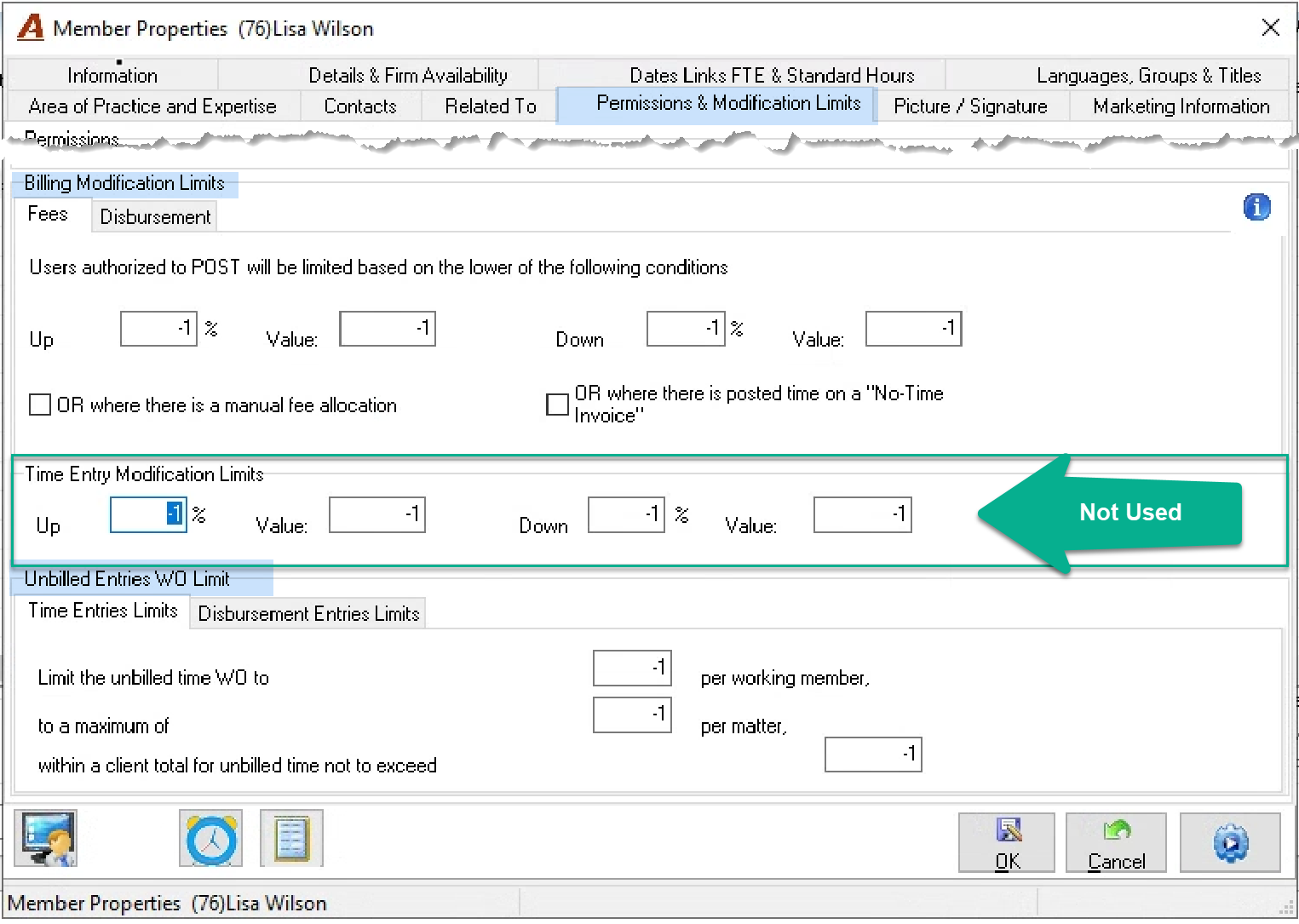
Modification limits are found within the “Permissions & Modification Limits” tab in member properties
Billing Modification Limits
The billing modification limits are used with a decentralized posting model. In environments where the preparers of the invoice are allowed to also post them, they can be restricted from posting if they have exceeded their billing modification limits and/or completed a manual fee allocation.
From a process perspective, once the modification limit is exceeded or the manual fee allocation completed, the posting function is no longer available, requiring the user to obtain authorization and submit the invoice to those responsible with ensuring control compliance for the posting of exceptions.
The billing modification limits including control for manual fee allocation overrides, do not have any application in centralized environments where the posting of invoices is a task restricted to the person responsible for ensuring compliance with firm policy whether there are changes or not.
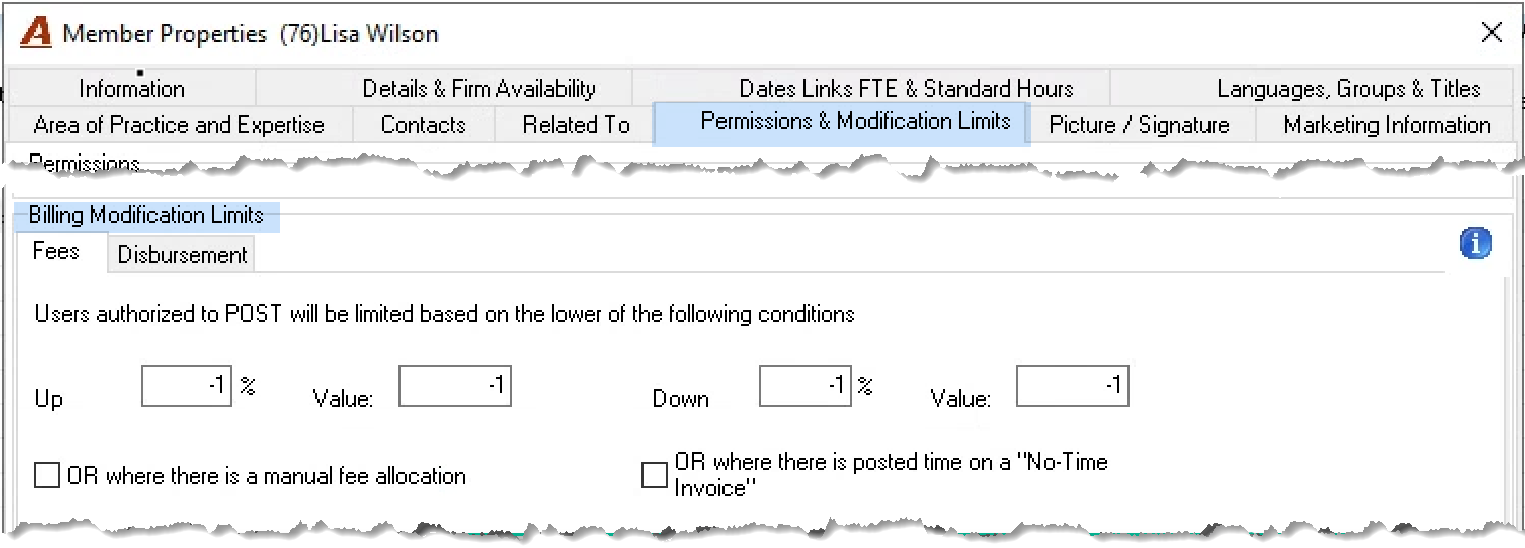
If both a percentage and a value limit are applied to the fee override process, the control for the invoice is based on the lower of the two.
A value of -1 is used for users that do not have a limit for posting invoices, for example accounting personnel; whereas a value of 0 implies that only unmodified invoices can be posted by this user.
Control of the “No-Time” Invoice.
To protect against the use and posting of a no-time invoice where there are worked values (time entries) without further authorization by a centralized desk, checkmark the option “OR where there is posted time on a “No-Time Invoice”.
Time Entry Modification Limits
This is currently not in use.
WIP WO Modification Limits
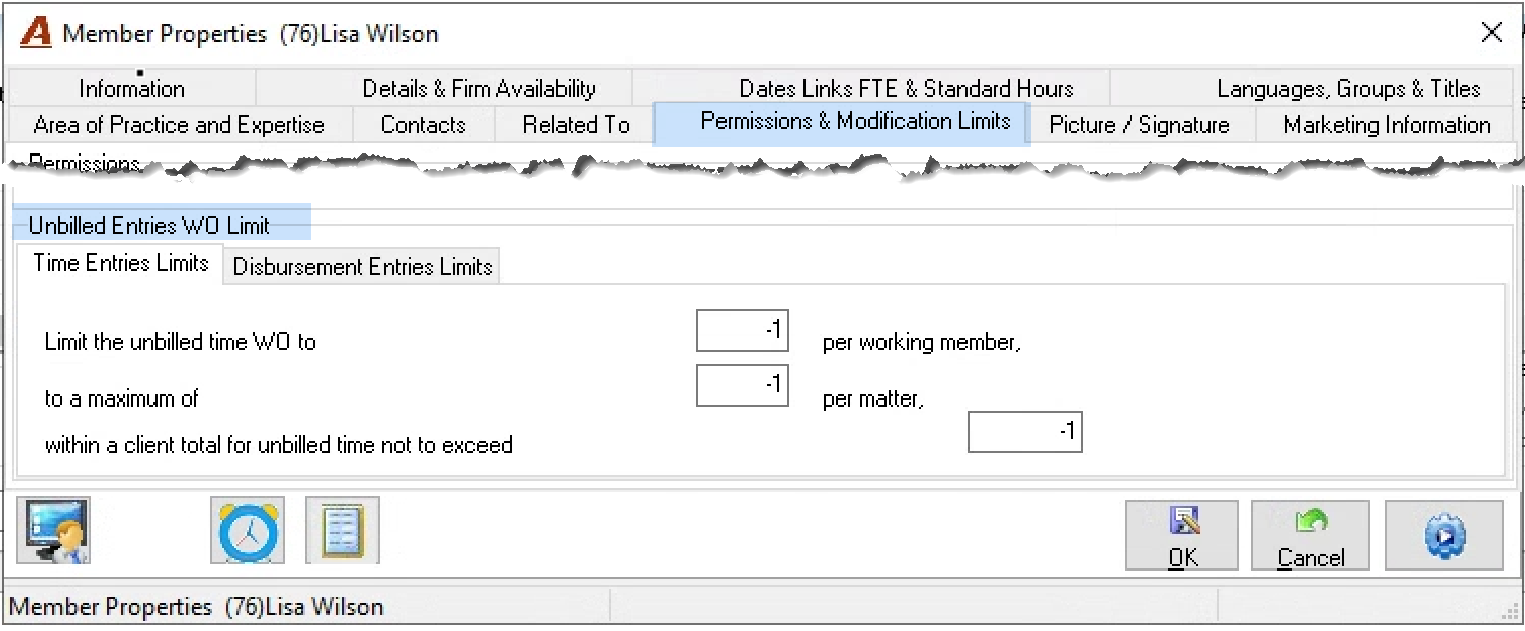
The WIP WO modification limits are used to facilitate the matter inactivation-to-close process. These limits are by working member or disbursement code, to a maximum for the matter and the client. In practical terms this means that regardless of who does the W/O, the user will be limited to the thresholds set in their member properties.
Unbilled time and disbursement write-offs are limited by the values set in member properties – permissions & modification limits tab. Once the maximums are met, write-offs become write-off requests to be processed by members with higher thresholds. -1 is used for not having a limit for completing unbilled entry write-offs, for example accounting personnel. 0 is used when the member can only complete unbilled entry write-offs as requests.
Time Entries Limits:
The member’s threshold for writing-off unbilled time can be set to a maximum of $XXX per working member but no more than $XXX per matter, so the sum of unbilled entry write-offs for multiple working members within the matter is limited. The client limit is used so the sum of unbilled entry write-offs for multiple matters is limited. As a result, members are not able to execute a write/off once it triggers a total that exceeds the limit set.
Disbursement Entries Limits:
The member’s threshold for writing-off unbilled disbursements can be set to a maximum of $XXX per disbursement code but no more than $XXX per matter- sum of multiple disbursement codes within the matter; and $XXX for the client – sum of multiple matters for the client. As a result, members are not able to execute a write/off once it triggers a total that exceeds the limit set.
Non-Chargeable Entries
The limits are not used to remove - equivalent of write-off - non-chargeable time, as there is no financial risk. The removal of non-chargeable entries is a simple status change, with no impact on recovery potential, as it is never considered an asset.